 how-to
Can You Aerate a Small Lawn Without Heavy Equipment?
Last Updated: November 3, 2026
Quick Summary
You can aerate a small lawn without heavy equipment by using a garden fork or a manual core aerator. Water the lawn about 1 inch the day before, then push tines 2 to 4 inches into moist soil, spacing holes 4 to 6 inches apart in strips like you mow.
- Push a screwdriver into the turf; if it takes real force, the soil is compacted.
- Aerate cool-season grasses in early fall or early spring when grass is actively growing.
- On a 1,000-square-foot lawn, expect roughly 400 to 600 holes for a single pass.
- Leave soil plugs on the lawn; they break down and return nutrients to the soil.
- Skip spike aerators on clay, since they can increase compaction instead of relieving it.
Table of Contents
- Why Small Lawns Get Compacted and What Aeration Fixes
- When to Aerate a Lawn for the Best Results
- What You'll Need Before You Start
- Step-by-Step: How to Aerate a Small Lawn by Hand
- Choosing a Manual Core Aerator for Your Lawn Size and Soil
- Spike vs. Core Aeration: What Actually Works
- Lawn Aeration Best Practices for Clay, Sandy, and Rocky Soil
- When Not to Aerate and How to Avoid Lawn Damage
- Frequently Asked Questions
Why Small Lawns Get Compacted and What Aeration Fixes
You can aerate a small lawn without heavy equipment, and for most yards under about 5,000 square feet it is the smarter choice. Walk-behind machines are awkward in tight spaces and cost money to rent. Hand tools do the same job on a smaller scale.
Lawn aeration is the process of making holes in the soil so air, water, and nutrients can reach the grass roots. On a small lawn, foot traffic does most of the damage. Small-yard owners can find the broader lawn care playbook for small yards that aeration fits into.
Hard soil causes three problems:
- Water pools on top instead of soaking in
- Roots stay shallow and dry out fast
- Fertilizer sits on the surface and washes away
Signs Your Soil Is Compacted
Push a screwdriver into the turf. If it takes real force to get it in, the soil is compacted. Other clues include puddles that linger after rain, thin patches along walkways, and grass that wilts within a day of watering.
Thatch makes it worse. A thick layer of dead stems and roots blocks air circulation and keeps water from reaching the soil. Aeration opens that layer up.
When to Aerate a Lawn for the Best Results
Aerate when the grass is actively growing and the soil is moist, not soaked. For cool-season grasses, Pennington's lawn care guidance points to early fall or early spring as the best window.
Timing matters more than technique. Aerating dormant grass in the middle of summer stresses it. Aerating waterlogged soil smears the holes shut and does nothing.
A simple test: water the lawn the day before. Then squeeze a handful of soil. It should hold together but crumble when you poke it.
Fall is the better of the two windows for most northern lawns. If you are weighing a fall pass, see whether seasonal aeration and overseeding are worth it. The grass is recovering from summer heat, weeds are winding down, and the holes you make stay open through winter.
What You'll Need Before You Start
At least 1 inch of water should be applied to the lawn before aeration, according to The Home Depot's aeration guide.
Here is the short list:
- Garden fork or manual core aerator
- Garden hose or sprinkler
- Work gloves
- Bucket for collecting soil plugs
- Water for yourself
Mark your sprinkler heads and shallow utility lines first. A call to your utility locator service can help you find buried lines before you dig.
Watch out: aerating over a shallow irrigation line or sprinkler head can crack the pipe and turn a one-hour job into a repair bill.
Step-by-Step: How to Aerate a Small Lawn by Hand
Plan the work before you push a tine. A simple coverage plan keeps you from missing patches or over-puncturing one strip while you rest.
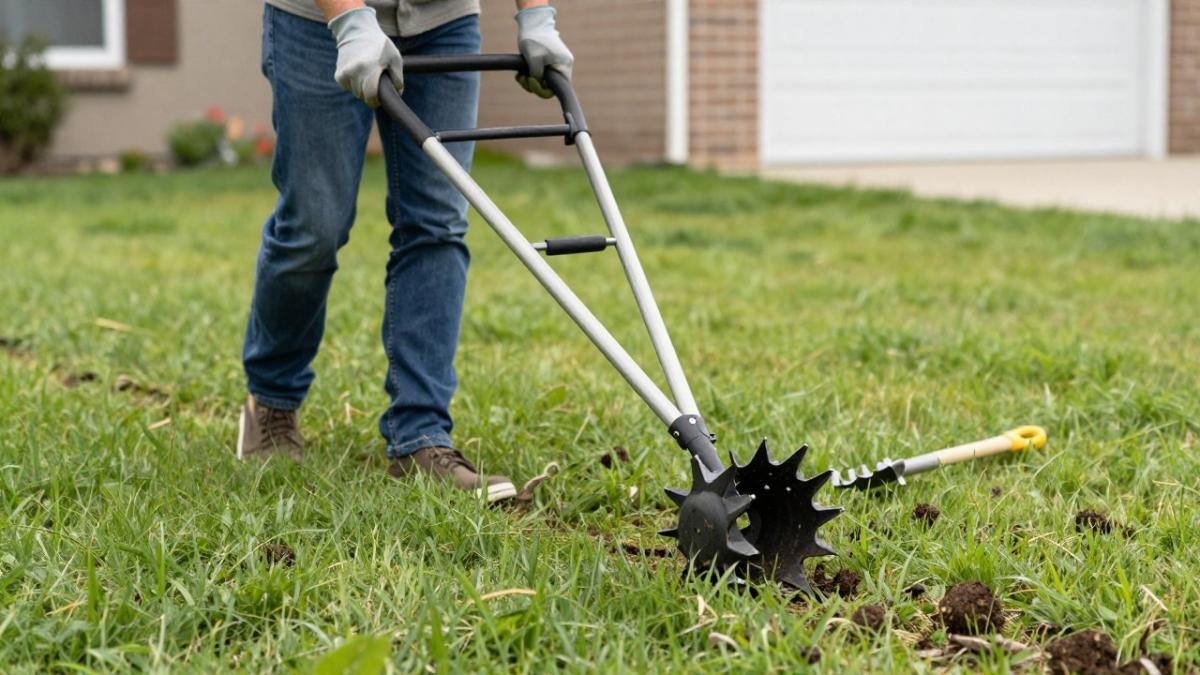
Time and effort by lawn size. These estimates assume moist soil, a manual core aerator, and a steady pace with short breaks:
| Lawn Size | Estimated Time | Passes | Notes |
|---|---|---|---|
| 500 sq ft | 20-30 min | 1 | One pass is enough; empty the tray twice |
| 1,000 sq ft | 45-60 min | 1 | The most common small-lawn size; plan a mid-job break |
| 2,000 sq ft | 1.5-2 hours | 1 | Split into two sessions if the soil is clay |
| 3,000-5,000 sq ft | 3-4 hours | 2 (perpendicular) | Two directions double the time; do it over two days |
A garden fork runs faster per square foot than a core aerator because there is no tray to empty, but it does less for clay. If you would rather not do it yourself, you can compare this DIY method with professional lawn aeration.
The spacing pattern. Work in strips the way you mow, and step off a consistent interval so holes land 4 to 6 inches apart. A simple method: set your feet shoulder-width apart, make one push per foot position, and move forward by one boot length between pushes. That produces a diamond pattern that covers evenly without measuring. On a 1,000-square-foot lawn, that is roughly 400 to 600 holes for a single pass.
Depth target. Push tines 2 to 4 inches into the soil. Shallower than 2 inches only opens the thatch layer; deeper than 4 inches risks hitting irrigation lines and tree roots on a small lot. If the tines will not reach 2 inches, the soil is too dry, water and wait a day rather than forcing it.
- Water the lawn the day before so the soil is moist but not muddy. Aim for about 1 inch of water; a tuna can set on the grass is a simple gauge.
- Mark sprinkler heads, shallow lines, and tree roots. Keep tines a few feet back from the trunk and work around the root zone rather than through it.
- Work in strips, the way you would mow, so you cover the whole yard evenly. Overlap each strip by about half a tine width to avoid missed patches.
- Space holes 4 to 6 inches apart using the boot-length method above.
- Push tines 2 to 4 inches into the soil. Rock the tool slightly forward and back to release the plug, then lift straight up.
- Empty the plug tray every few passes onto a bucket or directly back onto the lawn.
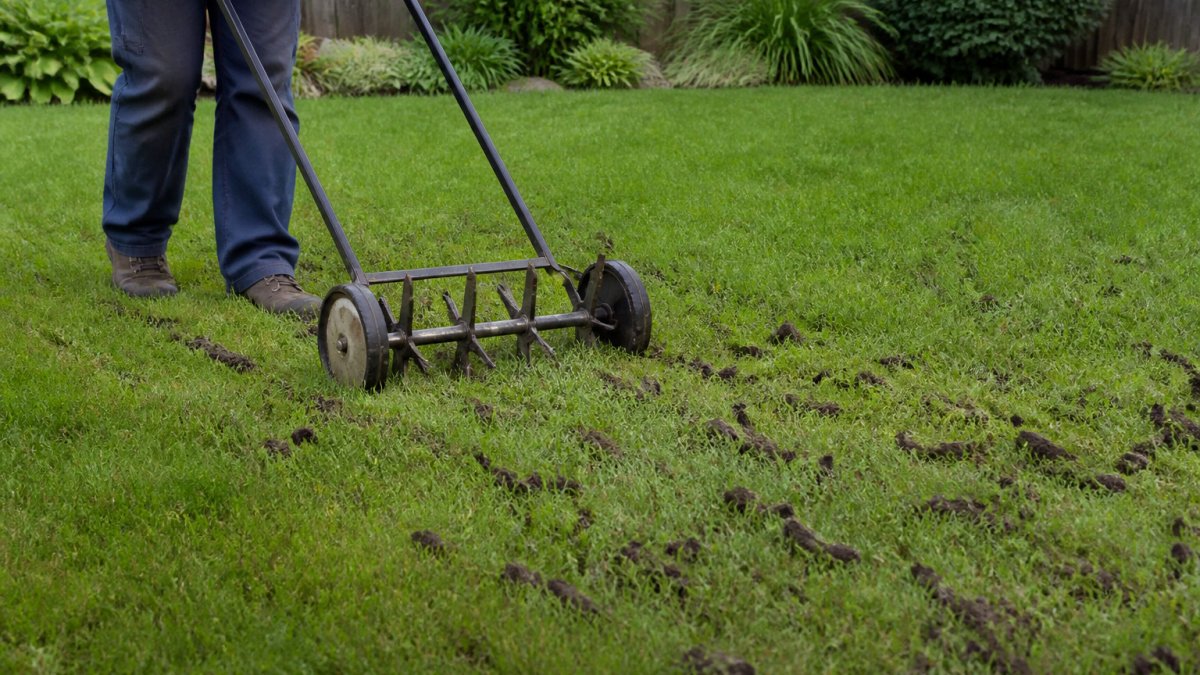
- Leave the soil plugs on the lawn. They break down and return nutrients; breaking them up with a rake speeds the process.
- Water lightly afterward and stay off the grass for a day or two.
Checking your coverage. After the first strip, look back at the holes. If you can lay a hand flat between holes without touching one, you are spacing too wide. If holes are touching, you are over-puncturing and wasting effort.
Choosing a Manual Core Aerator for Your Lawn Size and Soil
Most small-lawn mistakes come from buying a tool that is too big or too small for the job. Use this framework to pick once and stop second-guessing.
Start with soil type, then lawn size, then budget. Soil type decides whether you need to remove plugs at all. Lawn size decides how many passes you can tolerate.
| Lawn Size | Soil Type | Best Tool | Passes | Why |
|---|---|---|---|---|
| Under 1,000 sq ft | Loam or sandy | Garden fork | 1 | Cheap, fast, and the soil is soft enough that poking holes relieves compaction |
| Under 1,000 sq ft | Clay | Manual core aerator, 2-4 tines | 1 | Pulls plugs from hard soil instead of pressing it tighter |
| 1,000-3,000 sq ft | Any | Manual core aerator, 2-4 tines | 1 | Covers ground in roughly an hour at a steady pace |
| 3,000-5,000 sq ft | Any | Manual core aerator, 4 tines | 2 (perpendicular) | Two directions give even coverage without renting a machine |
| Any size | Rocky | Garden fork, worked slowly | 1 | A fork lets you feel and steer around stones; hollow tines bend or jam |
What to look for on the tool itself:
- Two to four hollow tines. Two tines are lighter and easier to push on clay; four tines cover more ground per step but require more force. On a lawn under 1,000 square feet, two tines are usually enough.
- A wide foot bar. You drive a manual core aerator with your foot, not your arms. A bar wide enough for both feet lets you use body weight instead of shoulder strength.
- A plug tray that empties from the top or side. You will empty it every few passes. A tray that requires disassembly will slow you down more than the tines will.
- Replaceable tines. Tines are the wear part. Models with bolt-on tines last longer than models with welded tines that must be replaced as a unit.
- Total weight under about 15 pounds. Heavier tools sink better on soft ground but wear you out on clay. For a small lawn, lighter wins.
Budget framing: a garden fork is a lower-cost entry and doubles as a digging tool.
Spike vs. Core Aeration: What Actually Works
Core aeration removes small plugs of soil. Spike aeration pushes solid tines into the ground without removing anything. TruGreen's comparison of the two methods notes that spike aeration can actually increase compaction, because it presses soil particles together instead of lifting them out.
That does not make spike tools useless. They are quick, and on sandy soil they open the surface just fine. But on a hard, compacted lawn, they make the problem worse over time.
For clay soil especially, core aeration is the more reliable answer. Readers in the Buckeye State can dig into whether core aeration is worth it for Ohio lawns.
Lawn Aeration Best Practices for Clay, Sandy, and Rocky Soil
Clay soil needs the most help. It holds water, drains slowly, and hardens like brick in summer.
Sandy soil drains fast and compacts less. A garden fork or a light core pass once a year is usually enough. Rocky ground is the tricky one.
If drainage is the real problem, aeration alone may not fix it. For a deeper fix, follow this step-by-step guide to fixing lawn drainage in heavy clay soil.
When Not to Aerate and How to Avoid Lawn Damage
Skip aeration in these situations:
- The soil is waterlogged or frozen
- The lawn is dormant from heat or drought
- You just applied a pre-emergent weed killer
- New grass has not had a full season to establish
Aerating at the wrong time opens the door to weeds and stresses weak grass. Also avoid aerating right before a heavy rain, since the holes fill with mud and seal shut.
One more caution: aerating around tree roots within the drip line can damage shallow roots. Keep tines a few feet back from the trunk and work around the root zone rather than through it.
Frequently Asked Questions
What is a cheap way to aerate my lawn without renting equipment?
A garden fork is the lowest-cost option: push it into moist soil every 4 to 6 inches and rock it back and forth to open channels. A manual core aerator costs more upfront but removes actual soil plugs, which is more effective on compacted ground. Both avoid rental fees, and for a small yard of a few hundred square feet, either gets the job done in an afternoon.
How deep should aeration holes be for a healthy lawn?
Tines should penetrate 2 to 4 inches into the soil. That depth reaches below the thatch layer and into the root zone, where air and water need to move. Shallower holes mostly punch through surface debris and do little for grass roots. Check your first few holes with a tape measure before committing to the whole lawn.
Can I use a pitchfork instead of an aerator?
Yes. A pitchfork or garden fork works as a manual aerator when the soil is moist. Push the tines in 2 to 4 inches, lean back slightly to widen each hole, then move 4 to 6 inches and repeat. It is slower than a hollow-tine tool and does not remove soil cores, but it improves air circulation and water penetration on small lawns without any equipment purchase.
What time of year is best to aerate a lawn?
Timing depends on your grass. Cool-season grasses should be aerated in early fall or early spring. Warm-season grasses do best in late spring or early summer when they are actively growing. Skip aeration during dormancy or heat stress, and never aerate waterlogged soil, because the tines will smear clay instead of opening it.
A small lawn does not need a machine, but it does need the right timing and a little patience. If the job feels like too much, or your soil is hard clay that hand tools barely dent, we can take it from here. Ward's Lawn Care & Landscape Co. has served Greater Cleveland since 1986, with free estimates, highly trained technicians, and full-service lawn care and fertilization. Get started with Ward's Lawn Care & Landscape Co. and give your grass the root space it needs.