 how-to
Organic Lawn Fertilizer for Beginners: A 2026 Guide
Last Updated: October 23, 2026
Quick Summary
Organic lawn fertilizer is a natural soil amendment made from plant, animal, or mineral sources that feeds grass while building long-term soil health. Unlike synthetics that deliver a quick nutrient spike, organic options work slowly over weeks or months, won't burn grass, and improve soil structure and water retention.
- Start with a soil test costing $15-30 before buying fertilizer to reveal exactly what your lawn needs.
- Apply organic fertilizer every 6-8 weeks during the growing season, starting in early spring when soil reaches 50°F consistently.
- Use a standard rate of one pound of nitrogen per 1,000 square feet, adjusting based on your product's nutrient percentage shown on the label.
- Choose products based on lawn symptoms: fish emulsion for pale thin growth, bone meal for weak roots, kelp meal for drought stress, or compost for poor soil structure.
- Water lightly after application to help organic fertilizer move into soil and activate.
Table of Contents
- What Is Organic Lawn Fertilizer and Why It Matters
- Best Organic Lawn Fertilizer Options for Your Lawn
- When to Fertilize Lawn Organically: Seasonal Timing
- Organic Lawn Fertilizer Application Rate: Getting the Numbers Right
- How to Apply Organic Lawn Fertilizer Evenly
- Common Mistakes to Avoid When Starting Out
- Soil Testing: The Foundation of Proper Fertilization
- Frequently Asked Questions
What Is Organic Lawn Fertilizer and Why It Matters
Organic lawn fertilizer is a natural soil amendment made from plant, animal, or mineral sources that feeds grass while building long-term soil health.
Here's what matters most for beginners: organic fertilizers won't burn your grass, while synthetics can damage tender blades if overapplied.
The trade-off is timing: organic fertilizers work slower than synthetics, so you need patience and a plan.
Best Organic Lawn Fertilizer Options for Your Lawn
Choosing the right product starts with understanding what your soil needs. According to Ohio State University Extension guidance on natural organic lawn care, organic fertilizers vary widely in their nutrient ratios.
For most lawns, look for products with a balanced nutrient ratio. The CFAES Knowledge Hub identifies that a 1:2 or 5:1:2 nutrient ratio works well for Ohio lawns.
If your lawn is thin and pale green overall, with slow growth after mowing: Your soil likely needs nitrogen.
If your lawn has weak roots, poor recovery from foot traffic, or you are establishing new grass: Phosphorus supports root development.
If your soil is compacted, rocky, or low in organic matter: Compost-based fertilizers are your best starting point.
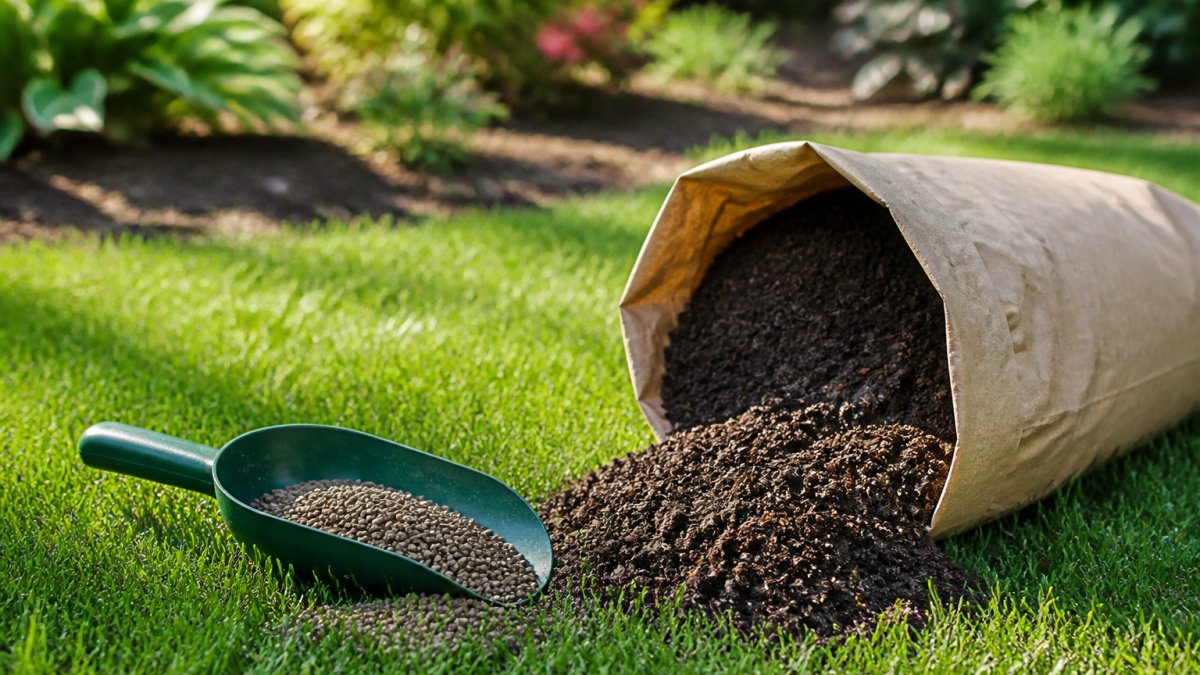
Common organic options include:
- Compost-based fertilizers, Made from decomposed plant matter. Slow-acting but excellent for soil structure. Best for lawns that need organic matter.
- Bone meal, High in phosphorus. Supports root development and flowering. Use when soil tests show low phosphorus.
- Fish emulsion, Fast-acting liquid option. High in nitrogen. Good for quick green-up in spring.
- Kelp meal, Adds trace minerals and micronutrients. Boosts stress resistance. Often mixed with other products.
- Alfalfa meal, Balanced nutrients with growth-promoting compounds. Gentle on grass. Works well for beginners.
The key is matching the product to your soil's actual needs. Ohio State University Extension emphasizes that many organic fertilizers do not meet a specific ratio need.
[Link to more specific product recommendations: Best Lawn Fertilizer for Clay Soil: A Guide and 5 Best Organic Fertilizers for Ohio Lawns]
When to Fertilize Lawn Organically: Seasonal Timing
Timing matters more than most beginners realize. Organic fertilizers work on the grass plant's natural growth cycles, apply at the wrong time and you're wasting product.
For Greater Cleveland lawns, the growing season runs from early spring through late fall.
Here's the practical schedule:
- Early spring (March-April), Apply your first feeding as soil warms and grass breaks dormancy. This jump-starts growth after winter.
- Late spring (May-June), Apply your second feeding 6-8 weeks after the first. Grass is growing fast and needs fuel.
- Early summer (July), Apply a lighter feeding or skip this month if temperatures spike above 85°F. Heat stress makes grass vulnerable.
- Early fall (September), Resume regular feeding as temperatures cool. This is the second most important feeding of the year. Fall growth builds strong roots for winter.
- Late fall (October-November), Final feeding before dormancy. This supports winter survival and spring green-up.
Avoid fertilizing in mid-summer heat or during drought. Stressed grass can't use the nutrients and you'll waste product.
[Learn more about seasonal timing: Lawn Fertilization Schedule for Ohio: 2026 Guide]
Organic Lawn Fertilizer Application Rate: Getting the Numbers Right
Application rate is where beginners often stumble. Too little and you don't see results. Too much and you waste money or create nutrient imbalances.
A standard application rate is one pound of nitrogen per 1,000 square feet, for both organic and synthetic products.
Here's how to figure it out:
-
Measure your lawn. Estimate or measure the square footage. Multiply length by width. If your lawn is 50 feet by 40 feet, that's 2,000 square feet.
-
Check the product label. The label shows the nutrient percentage. If it says "5-2-3," that means 5% nitrogen, 2% phosphorus, 3% potassium.
-
Calculate how much to apply. For 2,000 square feet needing one pound of nitrogen per 1,000 square feet, you need two pounds of nitrogen total. If your product is 5% nitrogen, divide 2 by 0.05. You need 40 pounds of product.
-
Follow package instructions. Most bags state how much to apply per 1,000 square feet. Use that as your guide.
Most homeowners find it easier to start with pre-measured bags labeled for lawn size. These remove the guesswork.
| Lawn Size | One Application | Application Frequency | Annual Amount |
|---|---|---|---|
| 1,000 sq ft | 1-2 lbs nitrogen | Every 6-8 weeks | 6-10 lbs nitrogen |
| 2,500 sq ft | 2.5-5 lbs nitrogen | Every 6-8 weeks | 15-25 lbs nitrogen |
| 5,000 sq ft | 5-10 lbs nitrogen | Every 6-8 weeks | 30-50 lbs nitrogen |
| 10,000 sq ft | 10-20 lbs nitrogen | Every 6-8 weeks | 60-100 lbs nitrogen |
Don't overthink this. Start with the label recommendation. Adjust next season based on results.
How to Apply Organic Lawn Fertilizer Evenly
But before you fill a spreader, do a five-minute inspection, it separates a good result from a wasted bag. Walk your lawn and check for these conditions:
- Thatch depth. Push a finger into the turf. If thatch (the brown layer between grass blades and soil) is deeper than about half an inch, fertilizer will sit on top and break down slowly. Rake or dethatch first, or use a liquid product that penetrates.
- Soil moisture. Squeeze a handful of soil. If it crumbles and will not hold shape, it is too dry. Water lightly the day before applying so granules can begin breaking down. If water squeezes out, it is too wet and you should wait.
- Bare spots and thin areas. Mark these with small flags. They need a lighter, more targeted pass, not a full-rate broadcast that can overwhelm struggling grass.
- Weeds and pest damage. If you see irregular dead patches, spongy turf that lifts easily, or chewed blades, identify the cause before fertilizing. Fertilizer feeds weeds as readily as grass, and stressed turf from pest damage will not use nutrients efficiently. [Learn more about identifying lawn problems: Lawn Disease vs. Drought: How to Tell the Difference]
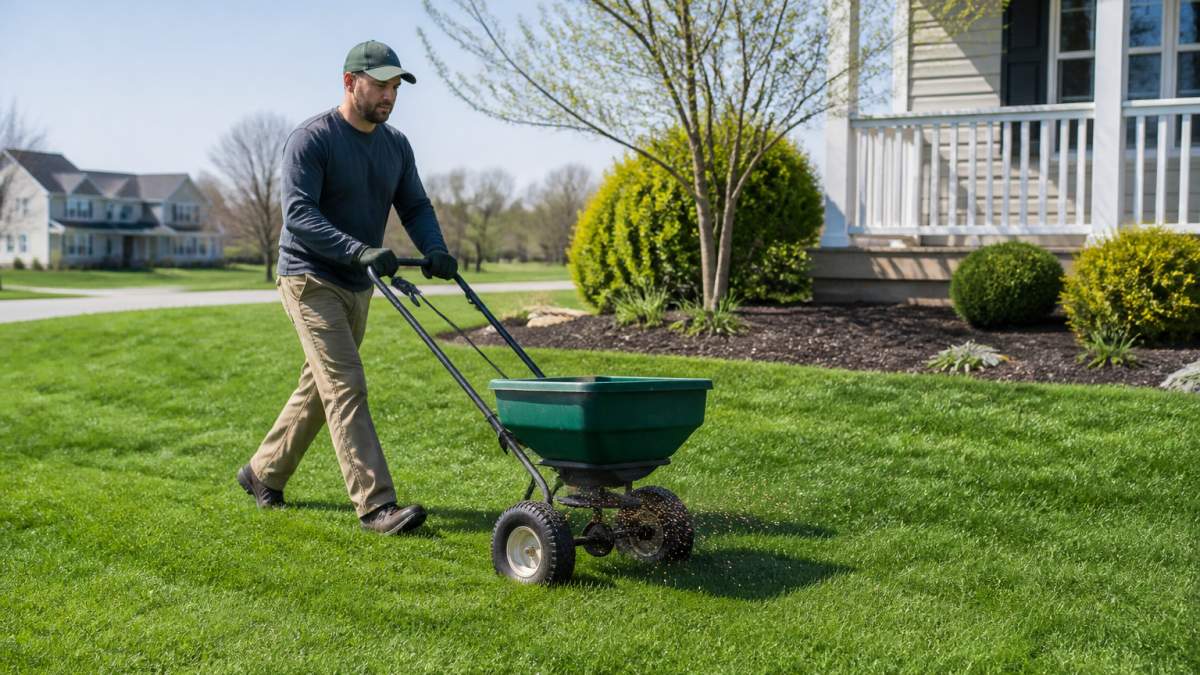
Two tools handle the application job well: broadcast spreaders and drop spreaders.
Broadcast spreaders throw fertilizer in a wide arc as you walk.
Drop spreaders release fertilizer directly below as you walk. They're more precise but slower, better for smaller lawns or detailed work near driveways.
Here's the step-by-step process:
-
Calibrate your spreader. Fill it with your measured amount of fertilizer. Walk a test area and adjust the opening until coverage looks even. Most spreaders have numbered settings, start at the middle and adjust up or down. A simple calibration test: spread a known weight over a measured 100-square-foot area on a driveway or tarp, then weigh what landed. Adjust until you hit your target rate.
-
Mow first. Cut your grass to normal height before fertilizing. This helps you see where you've already applied product.
-
Apply in overlapping passes. Walk in straight lines across your lawn. Overlap each pass slightly so you don't miss strips. Think of mowing patterns. For broadcast spreaders, overlap by about one-third of the spread width.
-
Go slow around edges. Use a drop spreader or reduce broadcast spreader speed near driveways and garden beds. Avoid over-applying near hardscapes.
-
Water after application. Light watering helps organic fertilizer move into the soil. Don't flood, just enough to settle the product. Aim for about a quarter-inch of water, which is roughly 15 minutes of typical sprinkler run time.
The whole process takes 30-45 minutes for a typical residential lot. Most people get faster with practice.
Troubleshooting after application: Dark green streaks a week later mean you overlapped too much, rake lightly and water to dilute.
Common Mistakes to Avoid When Starting Out
New organic fertilizer users make predictable errors. Knowing these saves time, money, and frustration.
Mistake 1: Skipping the soil test. Many beginners buy fertilizer based on marketing or neighbor recommendations.
Mistake 2: Applying too much too fast. Organic fertilizers are safe, but "safe" doesn't mean unlimited.
Mistake 4: Ignoring application timing. Applying fertilizer in mid-summer heat or during dormancy wastes product.
Mistake 6: Not watering after application. Organic fertilizers need moisture to activate and move into soil.
Soil Testing: The Foundation of Proper Fertilization
This section separates successful organic fertilizer users from frustrated ones: soil testing removes guesswork.
Your soil test reveals three critical things: nutrient levels (nitrogen, phosphorus, potassium), pH balance, and organic matter content. Armed with this data, you choose fertilizer that matches your lawn's actual needs.
Here's how to get a soil test:
-
Contact your local extension office. In Ohio, reach out to the Ohio State University Extension. They provide soil testing services for a small fee.
-
Collect samples correctly. Take soil from 4-6 spots across your lawn. Mix them together. Remove rocks and debris. Use the sample kit provided by the extension office.
-
Submit and wait. Results typically arrive in 1-2 weeks. You'll receive a detailed report showing nutrient levels and pH.
-
Read the recommendations. The report recommends fertilizer ratios based on your results. This is your shopping list.
[Learn more about soil pH and its impact on your lawn: Soil pH and Weed Growth: What Lawn Owners Need to Know]
Most soil tests cost $15-30 and save hundreds in wasted fertilizer, the single best investment for beginners.
Getting your lawn on an organic fertilizer program takes planning, but it's achievable for any homeowner. Start with a soil test, choose products that match your results, and apply on schedule.
Frequently Asked Questions
What is organic lawn fertilizer and how does it differ from synthetic fertilizer?
Organic lawn fertilizer comes from natural sources like plant materials, animal byproducts, and minerals. Unlike synthetic fertilizers that provide nutrients immediately, organic fertilizers release nutrients slowly as soil microorganisms break them down. This approach builds long-term soil health rather than delivering a quick nutrient spike. Organic fertilizers also improve soil structure and support beneficial microbes that make nutrients available to grass roots over time.
When should I apply organic fertilizer to my lawn?
Apply organic lawn fertilizer starting in early spring (March or April) when grass begins active growth. Continue applications every 6 to 8 weeks throughout the growing season. Timing depends on your specific grass type and local conditions, but spring and early fall are ideal periods. Soil testing through your local extension office will confirm the exact nutrient needs for your lawn, guiding when and what type to apply.
How much organic lawn fertilizer should I use?
A standard application rate is one pound of nitrogen per 1,000 square feet. However, your soil test results are the best guide, different lawns need different nutrient ratios. For Ohio lawns, a 1:2 or 5:1:2 nutrient ratio is often optimal. Always follow the product label instructions and adjust based on your soil test recommendations rather than guessing, as over-application wastes money and can harm turf.
Can organic lawn fertilizer burn my grass?
Organic fertilizers are less likely to burn grass than synthetic options because nutrients release slowly. However, improper application or extremely high rates can still cause damage. The key is following label directions, applying evenly, and watering after application to help nutrients move into the soil. If you're uncertain about application rates for your specific lawn, a soil test removes the guesswork and prevents costly mistakes.