 blog
blog
Best Lawn Fertilizer for Clay Soil: A Guide
Table of Contents
- Why Clay Soil Demands Different Fertilizer Strategies
- Understanding Lawn Fertilizer NPK Ratio for Clay Conditions
- Best Fertilizer for Grass in Clay Soil: Product Selection
- 1. Polymer-Coated Urea Blends (Best Overall for Established Clay Lawns)
- 2. Sulfur-Coated Urea (Best Budget Slow-Release)
- 3. Organic Granular Blends (Best for Building Clay Structure)
- 4. Composted Manure (Best Low-Cost Amendment-Fertilizer Hybrid)
- 5. Starter Fertilizer with Phosphorus (Best for New Seed and Overseeding)
- 6. Fast-Release Urea or Ammonium Sulfate (Use Sparingly)
- How to Choose
- When to Fertilize Lawn in Ohio: Seasonal Timing
- How to Improve Clay Soil for Lawns Before Fertilizing
- Application Rates and Calculation for Clay Lawns
- Frequently Asked Questions
Last Updated: October 7, 2026
Why Clay Soil Demands Different Fertilizer Strategies
Clay soil presents unique challenges that standard lawn fertilizer clay soil applications often fail to address. At Ward's Lawn Care & Landscape Co., we understand that clay requires a fundamentally different approach than sandy or loamy soils.
The problem isn't always the fertilizer itself, clay's structure prevents proper nutrient delivery. When water sits on the surface or roots can't penetrate compacted layers, even premium fertilizers disappoint.
Compaction also affects how fast-release versus slow-release fertilizers perform: a nutrient burst that works on well-draining soil can wash away or lock up in clay. The best approach combines soil amendment with strategic fertilizer selection.
Understanding Lawn Fertilizer NPK Ratio for Clay Conditions
The NPK ratio, nitrogen (N), phosphorus (P), and potassium (K), tells you the nutrient balance in any fertilizer. On clay, this ratio matters more because clay's nutrient-holding capacity is naturally high.
Nitrogen promotes leaf growth and green color, phosphorus supports root development, and potassium improves stress tolerance.
The key insight most guides miss: clay already holds nutrients well. Your goal isn't to add more, it's to make existing nutrients available. That's why slow-release formulas and organic amendments often outperform quick-fix, high-nitrogen products on clay.
Best Fertilizer for Grass in Clay Soil: Product Selection
Most guides stop at "use a slow-release fertilizer," which doesn't help you pick a bag off the shelf. Below is a ranked breakdown of fertilizer types that work on heavy clay, with nutrient analysis, release mechanism, best use case, and drawbacks. Rankings reflect how well each addresses clay's two core problems: nutrient lockup and poor infiltration.
1. Polymer-Coated Urea Blends (Best Overall for Established Clay Lawns)
Polymer-coated urea (PCU) is the workhorse for clay. Each prill is wrapped in a resin shell that releases nitrogen by osmosis over 8-16 weeks, driven by soil temperature rather than moisture. That matters on clay because moisture-driven release dumps nitrogen with every rain and stalls during dry spells.
- Typical analysis: 24-0-6, 25-0-5, or 22-0-4 with 50-100% coated nitrogen
- Release window: 8-16 weeks depending on coating thickness
- Best for: Established cool-season lawns, spring and fall feedings
- Drawbacks: Higher cost per pound of nitrogen than uncoated urea; prills can float on saturated clay and wash into gutters if applied right before a heavy rain
Look for a label stating the percentage of slow-release nitrogen (often "slowly available" or "water-insoluble" nitrogen). At least 30% coated nitrogen is a reasonable floor for clay.
2. Sulfur-Coated Urea (Best Budget Slow-Release)
Sulfur-coated urea (SCU) is cheaper than polymer-coated but releases faster and less predictably. The sulfur shell cracks with moisture and microbial activity, so release is partly weather-driven.
- Typical analysis: 21-0-0, 24-0-0, or blended into 20-5-10 type products
- Release window: 6-10 weeks
- Best for: Budget-conscious fall feeding on established lawns
- Drawbacks: Uneven release in cool soils; sulfur coating can acidify the soil surface slightly over years, which matters if your pH is already below 6.0
3. Organic Granular Blends (Best for Building Clay Structure)
Organic granular products do double duty: they feed the grass and add carbon that feeds the soil biology responsible for building aggregates in clay. Over two to three seasons, that structure is what actually improves infiltration.
- Typical analysis: 4-3-2, 5-4-4, 3-1-2 (low NPK, high organic matter)
- Release window: 4-8 weeks, microbially driven
- Best for: Lawns where the homeowner wants to rebuild soil, not just feed grass
- Drawbacks: Higher cost per pound of actual nitrogen; slow visible response (4-6 weeks); odor in humid weather; some products are derived from biosolids, which some homeowners prefer to avoid
4. Composted Manure (Best Low-Cost Amendment-Fertilizer Hybrid)
Composted manure isn't a precision fertilizer, but it's one of the most cost-effective ways to add nutrients and organic matter to clay at once.
- Typical analysis: Roughly 1-1-1 to 2-1-2, highly variable by source
- Release window: 6-10 weeks
- Best for: Fall applications, new-lawn prep, and lawns recovering from compaction
- Drawbacks: Variable nutrient content; weed seeds if not fully composted; salt content can be high in some feedlot-sourced products; not a substitute for a balanced fertilizer if a soil test shows a specific deficiency
5. Starter Fertilizer with Phosphorus (Best for New Seed and Overseeding)
New grass on clay needs phosphorus for root development, and clay's high phosphorus-holding capacity keeps what you apply in place rather than leaching. That's one of the few cases where clay works in your favor.
- Typical analysis: 12-12-12, 18-24-12, or 10-20-10
- Release window: 4-8 weeks, mostly fast-release
- Best for: Seeding or overseeding in late summer or early fall
- Drawbacks: Phosphorus runoff is a regulated concern in many areas; do not apply on frozen ground or before forecast heavy rain; check your state's phosphorus restrictions before broadcasting
6. Fast-Release Urea or Ammonium Sulfate (Use Sparingly)
Fast-release nitrogen has a narrow role on clay: a small, targeted boost during active growth when rain is already forecast. Outside that window, it's a runoff risk.
- Typical analysis: 46-0-0 (urea), 21-0-0 (ammonium sulfate)
- Release window: 2-4 weeks
- Best for: Spot-treating pale, actively growing turf in spring or early fall
- Drawbacks: Burn risk on dry clay; high runoff potential; not appropriate as a primary program on compacted clay
How to Choose
| Lawn Goal | First Choice | Second Choice |
|---|---|---|
| Established lawn, low effort | Polymer-coated urea blend | Sulfur-coated urea |
| Rebuilding clay structure | Organic granular | Composted manure |
| New seed or overseed | Starter fertilizer (with P) | Organic starter blend |
| Quick green-up before an event | Small dose of fast-release | , |
| Organic-only program | Organic granular | Composted manure + kelp meal |
When to Fertilize Lawn in Ohio: Seasonal Timing
Generic advice says "fertilize in spring and fall." That isn't a schedule. Below is a month-by-month calendar built around cool-season grass phenology (the growth stages Kentucky bluegrass, tall fescue, and perennial ryegrass go through) and the soil-temperature triggers that drive nutrient uptake on clay.
The Two Rules That Drive Everything
- Soil temperature, not air temperature, controls uptake. Cool-season grass roots take up nitrogen actively once soil at 2 inches holds 55°F and above. Below that, applied nitrogen sits in the clay and leaches or runs off.
- Clay holds nutrients, so timing matters more than rate. Because clay doesn't leach nitrogen like sand, a well-timed application lasts longer; a poorly timed one is wasted.
Month-by-Month Calendar
May, Main spring feeding window. Apply a slow-release, balanced or slightly nitrogen-leaning product (for example, a 24-0-6 polymer-coated blend) at label rate.
June, Stop feeding. Heat stress begins, cool-season grass slows top growth, and clay dries unevenly.
July, Do nothing. Dormancy or near-dormancy for most cool-season lawns.
September, The single most important feeding of the year. This fall feeding builds root reserves for winter and drives spring green-up.
November, Winterizer, optional. A late-season quick-release nitrogen application (a "winterizer") is debated. On clay, the risk is runoff during winter freeze-thaw cycles.
Clay-Specific Timing Adjustments
- Skip a feeding after heavy rain. If a storm is forecast within 24 hours, delay. Clay's slow infiltration means most of the nitrogen will leave the property.
- Do not feed a drought-stressed lawn. Wait for rain and recovery. Fertilizer on dormant, heat-stressed grass is wasted and can burn.
- Fall matters more than spring on clay. Because clay holds fall-applied nutrients through winter, the September and October feedings do more work per pound than the spring feeding.
- New seed gets its own schedule. Starter fertilizer at seeding, then no nitrogen until the new grass has been mowed two or three times.
How to Improve Clay Soil for Lawns Before Fertilizing
Fertilizing clay soil without first addressing its structural problems is like applying medicine to a blocked artery. Improve structure, drainage, and root penetration before expecting fertilizer to deliver results.
Soil Testing and pH Assessment
Start with a soil test.
Most Ohio clay soils run slightly acidic (pH 6.0-6.5), which is acceptable for cool-season grasses. If pH is below 6.0, add lime; above 7.5, sulfur can lower it.
Organic matter matters equally. Clay soils typically contain 2-4%; aim for 5% or higher.
Contact your local county extension office for affordable soil testing. Results arrive in 7-10 days with specific recommendations for your property.
Aeration and Drainage Solutions
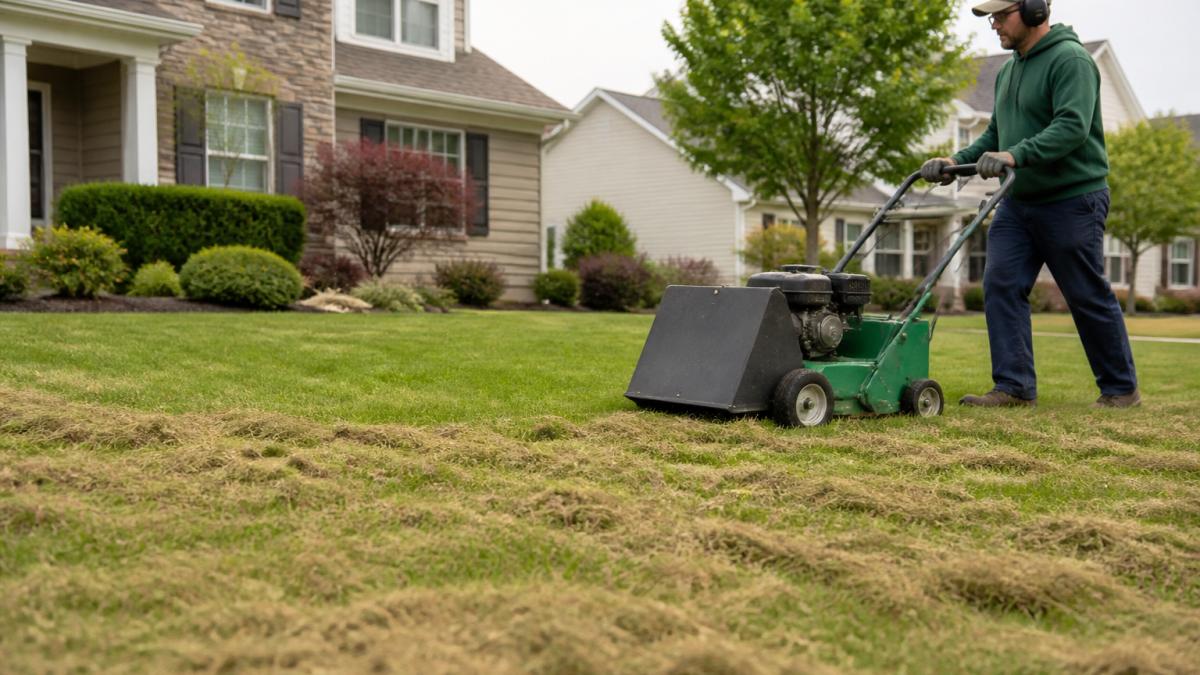
Mechanical aeration, using a core aerator to remove small soil plugs, is the single most effective clay soil improvement before fertilizing.
Aerate in fall (September-October) or spring (April-May) when soil moisture is moderate; bone-dry or waterlogged soil reduces effectiveness.
For severe compaction, aerate twice per year for the first two years. Most lawns improve significantly after 2-3 seasons of regular aeration.
Drainage solutions vary by severity. Surface grading, creating gentle slopes away from structures, helps water flow away rather than pool; for persistent wet spots, French drains or rain gardens redirect water.
Application Rates and Calculation for Clay Lawns
Applying the right amount prevents waste and reduces runoff risk.
Example: A 50-foot by 40-foot lawn equals 2,000 square feet, or 2 units of 1,000 square feet.
If your fertilizer recommends 1 pound per 1,000 square feet, you'd apply 2 pounds total.
For clay soils, apply at the lower end of recommended rates rather than the maximum.
Apply when grass is dry to prevent clumping.
Choosing the best lawn fertilizer for clay soil in Ohio means understanding that clay demands a different strategy than standard guides suggest.
Ward's Lawn Care & Landscape Co. provides comprehensive outdoor maintenance and landscape construction services for residential and commercial properties throughout Greater Cleveland. If you'd rather focus on enjoying your outdoor space than managing soil chemistry, our team handles the testing, timing, and application. Contact Ward's Lawn Care & Landscape Co. for a free estimate and let our highly trained technicians transform your clay soil into a thriving lawn.
Frequently Asked Questions
What is the best fertilizer for grass in clay soil?
The best lawn fertilizer for clay soil uses a slow-release formula with a balanced NPK ratio, typically 10-10-10 or 12-4-8, that prevents nutrient runoff common in heavy soil. Slow-release options reduce leaching and allow grass roots to absorb nutrients over time. Organic fertilizers with composted materials and humic acid also work well because they improve soil structure while feeding your lawn. Choose products specifically formulated for clay or heavy soils rather than generic lawn foods.
When should you fertilize your lawn in Ohio?
In Ohio, apply fertilizer in early spring (April to early May) when soil temperatures reach 55-60°F and grass begins active growth. Apply a second application in late summer or early fall (August to September) to strengthen root development before winter dormancy. Avoid fertilizing during peak summer heat or in winter. Cool-season grasses common to Ohio benefit most from fall fertilization, which promotes root development and spring vigor. Skip fertilizing during dry spells unless you can water thoroughly.
How does aeration help clay soil before fertilizing?
Mechanical aeration breaks up compacted soil, creating channels for water infiltration, root development, and nutrient uptake. In clay soil, compaction severely restricts drainage and root growth, making fertilizer less effective. Core aeration removes soil plugs, relieving compaction and allowing fertilizer nutrients to reach the root zone more efficiently. Aerate in spring or fall, preferably before or alongside your fertilization schedule. This combination addresses both the nutrient and structural problems that clay soil creates.
What NPK ratio works best for clay lawns?
For clay soil lawns, use a balanced NPK ratio of 10-10-10 or a ratio slightly higher in potassium, such as 12-4-8, to support root strength and stress tolerance. Nitrogen promotes leaf growth, phosphorus supports root development, and potassium improves drought resistance, all critical in clay soil where drainage is poor. Avoid high-nitrogen formulas (like 30-0-0) on clay because excess nitrogen increases runoff and disease risk. Always check your soil test results before selecting a ratio; clay soil may retain nutrients differently than sandy or loamy soils.