 how-to
7 Features That Make Lawn Weed Identification Easy
Last Updated: November 4, 2026
Quick Summary
Fast lawn weed identification starts by sorting the weed into one of two groups: broadleaf or grassy. Then read the leaf shape, margin, veins and arrangement, check the root and stem below the surface, and confirm with the seed head. Matching three or more traits gives you a solid ID.
- Broadleaf weeds have wide, net-veined leaves; grassy weeds have narrow blades with parallel veins.
- Nutsedge has a triangular stem, which separates it from most grasses.
- Dandelion leaves are deeply lobed with lobes pointing back toward the base.
- Take four photos: leaf top, leaf underside, whole plant, and the base at soil level.
- A good chart matches leaf shape, root type, growth habit, seed head, and annual or perennial.
Table of Contents
- Start With the Two Weed Categories: Broadleaf vs. Grassy
- Read the Leaves: Leaf Shape, Margins, and Arrangement
- Check the Roots and Stems Below the Surface
- Common Lawn Weeds With Pictures: What to Look For
- Grass-Like Lawn Weeds Identification: Telling Them Apart From Turf
- Lawn Weed Identification by Photo: Getting a Reliable Match
- Use a Lawn Weed Identification Chart to Confirm Your Guess
- Book a Free Lawn Weed Assessment With Ward's
- Frequently Asked Questions
Start With the Two Weed Categories: Broadleaf vs. Grassy
Every lawn weed falls into one of two groups: broadleaf or grassy. That single split is the fastest first step in how to identify common lawn weeds, and it cuts your search in half before you ever look at a leaf.
Broadleaf weeds have two seed leaves and wide, flat foliage. Think dandelions, clover, and plantain. Their leaves branch off a central stem or rise from a low rosette.
Grassy weeds look like grass because they are grass. They have narrow blades, parallel veins, and hollow or solid stems. Crabgrass and nutsedge are the classics.
Get this wrong and you may spray the wrong product. A broadleaf herbicide will generally do little to a grassy weed. So look at the leaf width first, then read the shape. For the full control picture after you sort your weeds, our guide on how to control weeds in your lawn walks through the seasonal plan.
Read the Leaves: Leaf Shape, Margins, and Arrangement
Leaf shape is the second clue and the one most people skip.
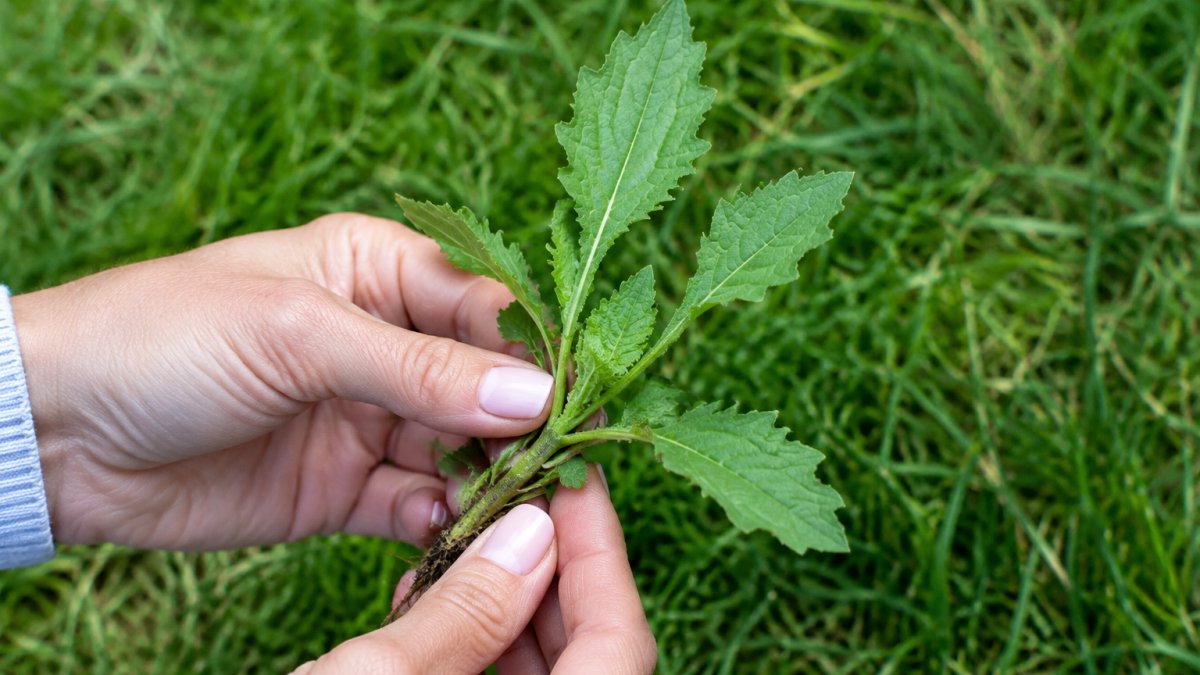
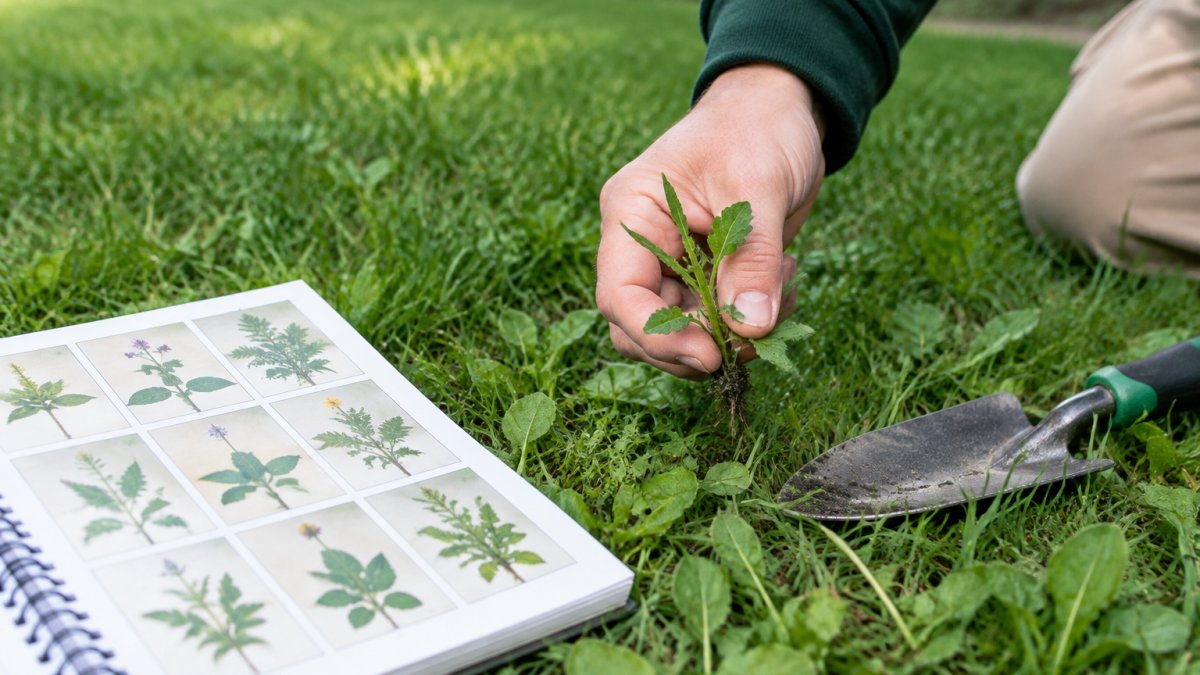
Check 1, Margin (the edge). Is it smooth, toothed, lobed, or wavy? Dandelion leaves are deeply lobed, with the lobes pointing back toward the base.
Check 2, Vein structure. Broadleaf weeds almost always show net-like veins that branch and rejoin.
Check 3, Arrangement on the stem. Do leaves grow opposite each other (two per node), alternate along the stem (one per node), or circle it in a whorl? Clover and many mint-family weeds are opposite. Dandelion and plantain rise from a basal rosette, so there is no stem arrangement to read at all, the leaves all emerge from one crown at soil level.
Check 4, Shape and texture. Oval, lance-shaped, heart-shaped, or arrow-shaped? Hairless or fuzzy? Hairy leaves are common on heal-all, mouse-ear chickweed, and horseweed.
A common mistake is judging a leaf from one angle. Pull one leaf, lay it flat, and photograph it top and bottom before you decide.
What the leaf can tell you about the soil. Leaf traits can also serve as soil indicators.
For the full control picture after you sort your weeds, our guide on how to control weeds in your lawn walks through the seasonal plan.
Check the Roots and Stems Below the Surface
Pull one weed and look at the root. The root type indicates how the plant spreads and how hard it can be to control.
Taproot: one thick main root, like a dandelion. Dig it out or it grows back.
Rhizomes and stolons: creeping stems that run along or under the soil. These spread a weed across a lawn fast. Bermudagrass and creeping bentgrass use them.
Fibrous roots: a dense mat of thin roots, common in grassy weeds.
Stem texture matters too. Feel the stem. Is it round or triangular? Nutsedge has a triangular stem, and that shape alone separates it from most grasses. Is it hollow or solid? Hairy or smooth?
Watch out: pulling a rhizome weed and leaving root pieces behind can allow it to return. If you see creeping stems, you are likely dealing with a perennial that needs a different plan than a simple annual.
Common Lawn Weeds With Pictures: What to Look For
Photos help, but only if you know what the photo is showing. Match your weed to these common ones by their standout feature.
- Dandelion: lobed rosette leaves, yellow flower, taproot, puffy seed head
- Clover: three leaflets, sometimes a white flower, spreads by stolons
- Plantain: oval leaves with parallel ribs, tough taproot
- Crabgrass: coarse grassy blades, spreads flat, dies back each year
- Nutsedge: triangular stem, yellow-green, loves wet spots
The seed head is a strong final clue. Dandelion sends up a round puffball. Plantain sends a thin spike of tiny flowers. Crabgrass produces finger-like seed spikes in late summer.
Once you have a name, our seven methods for stopping persistent lawn weeds give you a plan that targets the plant you found.
Match your weed to these common ones by their standout feature.
| Weed | Standout features |
|---|---|
| Dandelion | Lobed rosette leaves, yellow flower, taproot, puffy seed head |
| Clover | Three leaflets, sometimes a white flower, spreads by stolons |
| Plantain | Oval leaves with parallel ribs, tough taproot |
| Crabgrass | Coarse grassy blades, spreads flat, dies back each year |
| Nutsedge | Triangular stem, yellow-green, loves wet spots |
Grass-Like Lawn Weeds Identification: Telling Them Apart From Turf
Grassy weeds fool people because they look like the lawn. The trick is to compare the weed to your turfgrass blade by blade.
Look for these differences:
- Blade width and tip: crabgrass blades are wider and coarser than most turf
- Stem shape: roll it between your fingers. Triangular means nutsedge, not grass
- Growth habit: does it spread flat and outward, or grow upright?
- Color: many grassy weeds run lighter or yellower than the surrounding turf
Crabgrass spreads low and flat in a star pattern. Nutsedge grows faster than the lawn and stands taller within days of mowing. If a patch outgrows your grass right after a cut, nutsedge is a likely suspect.
Seed heads separate them too. Crabgrass seed spikes look like fingers. Nutsedge has a small, spiky cluster at the top.
Lawn Weed Identification by Photo: Getting a Reliable Match
A photo can confirm a guess, but a bad photo gives a bad match. Good lawn weed identification by photo needs the right shots, and a fixed order for comparing them, so you are not bouncing between five tabs and guessing.
Take these four photos before you search:
- A close-up of a single leaf, top side, filling the frame
- The same leaf, underside, in the same light
- The whole plant, showing how it grows, upright, flat, or in a rosette
- The base, where the stem meets the soil, so the root crown and any creeping stems are visible
Add one full-lawn shot so you can see the weed against the turf. Shoot in daylight, not shade, and keep your hand and shadow out of the frame.
Run the photos through a decision tree, not a list. Most people upload a photo and scroll until something looks close. That is how you end up treating a sedge as a grass. Instead, compare in this order and stop at the first trait that does not match:
- Step 1, Broadleaf or grassy? Wide, net-veined leaves mean broadleaf. Narrow, parallel-veined blades mean grassy. If it looks grassy but has a triangular stem, it is a sedge, not a grass, go to the nutsedge check.
- Step 2, Growth habit. Flat and spreading in a star pattern points to crabgrass. Upright and taller than the surrounding turf within days of mowing points to nutsedge. A low rosette points to dandelion or plantain.
- Step 3, Margin and vein. Lobed with net veins is dandelion. Smooth with parallel ribs is plantain. Three leaflets is clover.
- Step 4, Root and stem. Taproot, rhizome, or fibrous? Round or triangular stem? Hollow or solid? The root is usually the tiebreaker between similar species.
- Step 5, Seed head. Round puffball is dandelion. Thin spike is plantain. Finger-like spikes are crabgrass. A spiky cluster at the top of a triangular stem is nutsedge.
If your photos match three or more traits in that order, you have a solid ID. If they match only the leaf but not the root or growth habit, keep looking, similar species get confused, and the root is often the tiebreaker.
Where to compare. University extension offices publish weed photo libraries with clear leaf, root, and seed-head shots, and those are more reliable than random image results, which often mislabel similar species.
What the photo is really telling you. A photo taken in the same spot two years running is a soil record. If the same weed keeps returning to the same patch, the photo is showing you a compaction, drainage, or pH pattern, not a one-off plant. Our guide on soil pH and weed growth explains how pH and compaction push certain weeds to take over.
If you want to handle the weed without chemicals, our guide on natural alternatives to chemical weed killers covers your options once you know the plant.
Use a Lawn Weed Identification Chart to Confirm Your Guess
A lawn weed identification chart is the last check, not the first step. Use it to confirm what your eyes and photos already suggest.
A good chart matches on these traits together:
- Leaf shape and margin
- Root type
- Growth habit, upright or flat
- Seed head
- Whether it is annual or perennial
If your weed matches three or more traits, you have a solid ID. If it matches only the leaf but not the root or growth habit, keep looking. Similar species get confused, and the root is often the tiebreaker.
Soil tells you why a weed is there. Weeds often signal a soil problem, and our guide on soil pH and weed growth explains how pH and compaction push certain weeds to take over. Fix the soil and the weed pressure drops.
Book a Free Lawn Weed Assessment With Ward's
If you have pulled, sprayed, and still see the same weeds every spring, the problem is usually deeper than the plants you can see. That is where we come in.
Ward's Lawn Care & Landscape Co. has served Greater Cleveland since 1986. Our highly trained technicians provide routine lawn care and fertilization as well as full landscape construction. We offer free estimates.
Here is what we offer:
- Discounts when you hire for multiple services
- Rewards for referring friends and family
You do not need to guess at every weed. Contact Ward's Lawn Care & Landscape Co. to request a free estimate.
Frequently Asked Questions
How can I tell what weeds are in my lawn?
Start with the leaf. Note the shape, whether the edges are smooth, toothed, or lobed, and how leaves attach to the stem. Then check the root by digging one plant up with a trowel: a single deep taproot points to dandelion or plantain, while fibrous mats or creeping rhizomes suggest grasses and ground ivy. A lawn weed identification chart or a photo comparison confirms the match before you treat anything.
What are some common lawn weeds that look like grass?
Crabgrass, goosegrass, and annual foxtail are the usual culprits. Crabgrass spreads flat and wide from a center point and sends out finger-like seed heads in late summer. Goosegrass looks similar but has a lighter, silver center and thicker stems. Tall fescue clumps also blend into turf until you notice the coarser blades and wider leaf. Grass-like lawn weeds identification depends on seed head shape and growth habit more than color.
When is the best time to identify lawn weeds?
Late spring through early summer is easiest because most broadleaf weeds are flowering and easy to spot, and grassy weeds are mature enough to show their seed heads. A second window opens in early fall when perennial weeds rebuild root reserves. Walk the lawn in the morning after dew, when leaf shape and growth habit stand out against the turf. Photograph anything unfamiliar before mowing, since cut weeds lose the features you need.
Can I identify a weed from a photo alone?
Often, yes, but the photo needs the right details. Capture the whole plant, a close-up of the leaf top and underside, the stem where it meets the soil, and any flower or seed head. Include something for scale. Lawn weed identification by photo works best when the plant is flowering or seeding, because leaf shape alone can match several species. Send clear photos to a lawn care professional if you are unsure.
The weeds you see are a symptom, and the fix starts with knowing exactly what you are dealing with. If you would rather hand off the guesswork, Ward's Lawn Care & Landscape Co. brings decades of local experience, honest recommendations, and free estimates to every property. Get started with Ward's Lawn Care & Landscape Co. and turn your lawn into one you are proud to walk barefoot on.