 how-to
How to Budget for Commercial Property Repairs
Last Updated: November 5, 2026
Quick Summary
Budget for commercial property repairs by setting a baseline from a system-by-system condition assessment, then funding a repair reserve monthly rather than annually. Size the reserve to the system-level accrual and add an emergency cushion of ten percent of the annual reserve.
- The replacement-value method sets aside 1% to 2% of replacement value yearly for maintenance and repairs.
- The per-square-foot method puts annual maintenance at $0.80 to $4.50 per square foot.
- Fund the reserve monthly, not annually, so cash is available when a system fails.
- Walk the property twice a year with a written checklist to turn worry into priced line items.
- Track spending by property, system, and vendor, and review the budget every quarter.
Table of Contents
- Step 1: Set Your Commercial Property Maintenance Budget Baseline
- Step 2: Build a Commercial Property Repair Reserve That Holds Up
- Step 3: Work Through a Commercial Property Maintenance Checklist
- Step 4: Estimate Commercial Landscaping Maintenance Costs
- Step 5: Separate Planned Repairs From Emergency Spending
- Step 6: Track Spending by Property, System, and Vendor
- Step 7: Review and Adjust Your Repair Budget Every Quarter
- Common Mistakes to Avoid When Budgeting for Commercial Property Repairs
- Frequently Asked Questions
Step 1: Set Your Commercial Property Maintenance Budget Baseline
A repair budget needs a baseline that reflects what your building actually is: its age, its systems, and their remaining useful life. Two rules of thumb get you into the right range, but neither tells you which repairs are coming or when. Use them as a sanity check, then build the real number from a system-by-system condition assessment.
Start With the Two Rules of Thumb
The replacement-value method sets aside 1% to 2% of your property's replacement value each year for maintenance and repairs, according to Oxmaint's 2026 maintenance budget planning guide. A building with a $2 million replacement value carries a $20,000 to $40,000 annual line. Older buildings, or those with deferred maintenance, belong at the higher end.
The per-square-foot method is simpler. QQ Property Solutions' 2026 commercial maintenance budget guide puts annual maintenance at $0.80 to $4.50 per square foot, depending on property type and age.
| Method | Formula | Best For |
|---|---|---|
| Replacement value | 1%-2% of value per year | Mixed portfolios, older buildings |
| Per square foot | $0.80-$4.50 per sq ft per year | Single buildings, quick estimates |
Convert the Rule of Thumb Into a Repair Baseline
A single percentage hides the fact that repairs do not arrive evenly. A roof replacement lands in one year; sealcoat and striping land every few years; HVAC compressors fail on their own schedule. Build the baseline by listing each major system, noting its age and expected service life, and estimating the cost to repair or replace it. Divide that future cost by the remaining years of service life to get an annual accrual for that system. Sum the accruals and compare the total to the rule-of-thumb range. If the system-level number is higher, trust the system-level number.
The systems that drive most commercial repair budgets are:
- Roof membrane, flashing, and drainage
- Parking lot pavement, sealcoat, striping, and storm drains
- HVAC equipment and controls
- Exterior lighting, signage, and electrical distribution
- Plumbing, irrigation, and site utilities
- Building facade, entry doors, and windows
- Sidewalks, curbs, stairs, and accessibility features
Adjust for Condition, Not Just Age
Age alone overstates some systems and understates others. A 15-year-old roof that has been maintained may have years left; a 7-year-old roof with ponding water may not. Walk each system, record its condition on a simple scale (good, fair, poor, end-of-life), and adjust the accrual up or down. Document the walk with photos and dates so next year's baseline starts from evidence rather than memory.
Watch out: a baseline built only from last year's actual spending will always lag, because last year's spending reflects last year's failures, not the repairs already queued up in the building's systems.
Step 2: Build a Commercial Property Repair Reserve That Holds Up
A repair reserve is money set aside each year for the repairs you know will come. Roofs age. Sealcoat wears. Irrigation lines crack. The reserve turns those surprises into planned spending, and it is the line item that separates a budget that survives a bad year from one that does not.
Separate the Reserve From the Operating Budget
The operating budget covers routine, recurring work: mowing, cleaning, filter changes, minor touch-ups. The reserve covers non-recurring repairs and replacements: a roof section, a pavement overlay, an HVAC compressor, a parking lot light pole. Mixing the two hides the true cost of ownership and makes it easy to spend reserve money on routine work. Keep them in separate accounts or, at minimum, separate line items with separate approval thresholds.
Fund Monthly, Not Annually
Fund the reserve monthly, not annually. A $30,000 annual reserve becomes $2,500 per month. That rhythm keeps cash available when a compressor fails in July, and it spreads the burden across the fiscal year instead of concentrating it in one budget cycle. Set the monthly transfer as a fixed line item so it competes for cash alongside payroll and utilities rather than being the first thing cut.
Size the Reserve to the System-Level Baseline
Use the system-level accrual from Step 1 as the reserve target, not last year's spending. A reserve built only from prior-year actuals will always run short, because it funds the failures that already happened rather than the ones queued up. Recalculate the target annually as systems age and condition changes.
Layer a Small Emergency Fund on Top
Even a well-funded reserve meets surprises: a storm, a failed water heater, a parking lot light knocked down by a plow. Budget an emergency cushion on top of the reserve. Ten percent of the annual reserve is a reasonable starting point for a single property; larger portfolios may need a portfolio-level cushion instead of one per building.
Document the Reserve for Lenders and Investors
Lenders, buyers, and investors increasingly ask for evidence that a property is being reserved for. Keep a simple reserve schedule that shows each system, its condition, its estimated replacement cost, its remaining life, and the annual accrual. The schedule does double duty: it justifies the budget internally and it answers diligence questions externally without a scramble.
Watch out: a reserve that is funded but never drawn on looks healthy until a roof fails, at which point the property manager discovers the reserve was sized to routine maintenance rather than to the systems it was meant to replace.
Step 3: Work Through a Commercial Property Maintenance Checklist
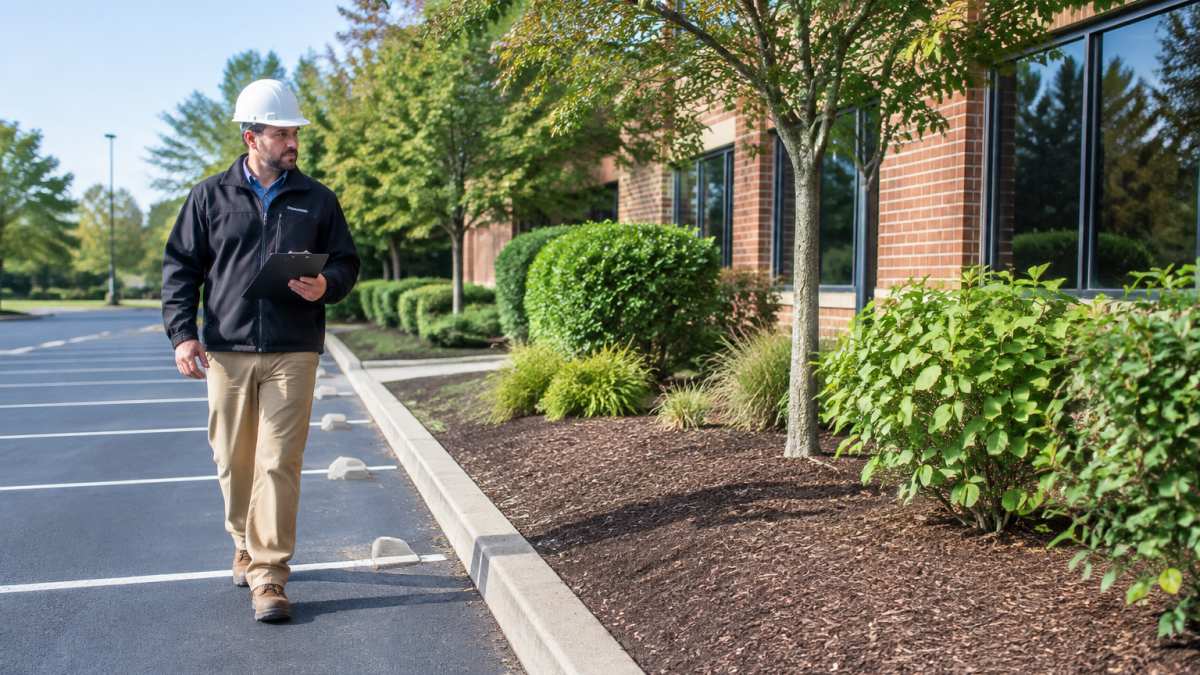
Walk the property twice a year with a written checklist. A checklist turns vague worry into line items you can price and schedule. For a deeper walkthrough of exterior items, see our guide to commercial property exterior maintenance tips.
Cover these areas on every walk:
- Roof, flashing, and gutters
- Parking lot pavement, striping, and drains
- Sidewalks, curbs, and stairways
- Landscaping beds, trees, and irrigation
- Exterior lighting and signage
- Building facade and entry doors
The man is American.
Step 4: Estimate Commercial Landscaping Maintenance Costs
Landscaping is the line item most budgets underestimate. Mowing, bed care, seasonal color, tree trimming, and irrigation checks all carry separate costs. Commercial landscaping maintenance costs also swing with property size, plant count, and how much curb appeal you want to protect.
Ask vendors what the contract covers before you sign. Our guide to commercial groundskeeping services explains what a full-service contract includes. If curb appeal is a priority, read maintaining curb appeal for commercial properties to see which upkeep tasks protect it.
Step 5: Separate Planned Repairs From Emergency Spending
Planned repairs come from your checklist. Emergency spending comes from ignored warning signs. The goal is to shift money from the second bucket to the first.
Roof work is the clearest example. A small leak caught early stays in the planned column. A soaked ceiling deck does not. Our article on commercial roof warning signs shows what to look for before a repair becomes an emergency.
Budget a small emergency fund on top of the reserve. Ten percent of the annual reserve is a reasonable cushion.
Step 6: Track Spending by Property, System, and Vendor
A single portfolio total hides where money actually goes. Operio's commercial property maintenance guidance recommends tracking spending by property, system, and vendor, because a portfolio-level number gives you no detail to manage against.
Set up three views in your spreadsheet:
- By property: which building is over budget
- By system: roof, pavement, landscaping, lighting
- By vendor: who is delivering value
When you evaluate groundskeeping vendors, our guide to hiring reliable commercial groundskeeping covers the criteria that separate dependable crews from the rest.
Step 7: Review and Adjust Your Repair Budget Every Quarter
Quarterly reviews keep the budget honest. Compare actual spending to plan, then adjust the reserve for the next quarter. Prices move. Weather shifts. A budget set in January rarely fits December.
Ask three questions each quarter:
- Which system ran over, and why?
- Which vendor delivered the most for the money?
- What new warning signs appeared on the last walk?
Write the answers down. Next year's baseline starts there.
Common Mistakes to Avoid When Budgeting for Commercial Property Repairs
The biggest mistake is treating the budget as a single portfolio number. It hides the property that is quietly falling apart.
Other common errors:
- Skipping the annual property walk
- Funding the reserve once a year instead of monthly
- Ignoring landscaping until curb appeal suffers
- Letting small roof and pavement issues become emergencies
- Never reviewing actual spending against plan
Budgeting for commercial property repairs works when you set a real baseline, fund a reserve monthly, and review it every quarter. If landscaping and exterior upkeep keep landing on your to-do list, Ward's Lawn Care & Landscape Co. can take that work off your plate. We've served Greater Cleveland since 1986 with full-service outdoor maintenance, from routine groundskeeping to landscape construction. Our technicians handle the details, and you get free estimates plus discounts when you bundle multiple services. Get started with Ward's Lawn Care & Landscape Co. and put your exterior maintenance on a schedule you can budget for.
Frequently Asked Questions
How much should a commercial property owner set aside for repairs?
Two common methods give you a starting point: a percentage of the property's replacement value, and a per-square-foot approach. Check current published guidance for the figures that fit your property type. Older buildings and properties with deferred work should sit at the higher end of whichever range you use.
What should a commercial property maintenance budget include?
A complete commercial property maintenance budget covers more than interior repairs. Build line items for exterior groundskeeping and landscaping, parking lot and walkway upkeep, lighting and signage, seasonal cleanup, and a contingency amount for unplanned work. A commercial property maintenance checklist helps here: walk the site quarterly, note every system and area, and assign each one a recurring cost. Without that breakdown, a portfolio-wide total hides which property or system is actually draining the budget.
How can preventive maintenance reduce commercial property repair costs?
Preventive work trades small scheduled costs for large unscheduled ones. Regular groundskeeping keeps drainage paths clear, stops overgrowth from damaging pavement edges, and catches irrigation leaks before they undermine a walkway. The same logic applies to exterior lighting and signage. Because a commercial property repair reserve is meant to absorb surprises, every surprise you prevent is money that stays in the reserve. Review your commercial property maintenance checklist each quarter and move recurring small fixes into the planned budget.
How often should a commercial property repair budget be reviewed?
Quarterly reviews work for most properties, with a full annual reset against current replacement value. Track maintenance spending by property, system, and vendor so each review has real numbers behind it. If a single line item, such as commercial landscaping maintenance costs, runs more than 10% over its allocation two quarters in a row, adjust the baseline rather than patching it from contingency. A commercial property repair reserve that is never reviewed slowly drifts away from what the property actually needs.