 listicle
Does Your Commercial Roof Need Repair? Warning Signs
Last Updated: November 1, 2026
Quick Summary
Signs your commercial roof needs repair include cracks, blisters, and punctures in the membrane, damaged flashing, ponding water that stays more than 48 hours after rain, interior water stains or mold, and sagging. Treat any single sign as a prompt to investigate, and any combination as a reason to call a professional.
- The National Roofing Contractors Association recommends routine inspections twice a year plus after major storms.
- Ponding water is standing water that remains more than 48 hours after rain and adds weight while accelerating membrane breakdown.
- Act today on water dripping onto electrical panels or server rooms, visible sagging, or a puncture before a forecast storm.
- If repairs are needed in three or more separate areas within a single year, the roof is telling you something.
- Photograph each issue with something for scale and note the date and location on the roof.
Table of Contents
- Why Early Commercial Roof Repair Saves You Money
- 8 Signs Your Commercial Roof Needs Repair
- Your Commercial Roof Inspection Checklist
- Commercial Roof Maintenance Tips That Prevent Costly Repairs
- Commercial Roof Repair vs Replacement: How to Decide
- How to Document Roof Damage Before an Inspection
- Request a Free Commercial Roof Assessment
- Frequently Asked Questions
Why Early Commercial Roof Repair Saves You Money
A small blister on a commercial flat roof looks harmless. For a closer look at how roof condition affects overall property value, see our article on maintaining curb appeal for commercial properties.
Timing matters more than severity. The National Roofing Contractors Association recommends routine inspections twice a year plus after major storms, because most roof failures start small and stay hidden until water finds a path inside.
8 Signs Your Commercial Roof Needs Repair
These eight warning signs matter most on low-slope and flat commercial roofs. Some you can spot from the ground; others need a roof walk or a look at the ceiling below. Treat any single sign as a prompt to investigate, and any combination as a reason to call a professional.
Visible Surface Damage: Cracks, Blisters, and Punctures
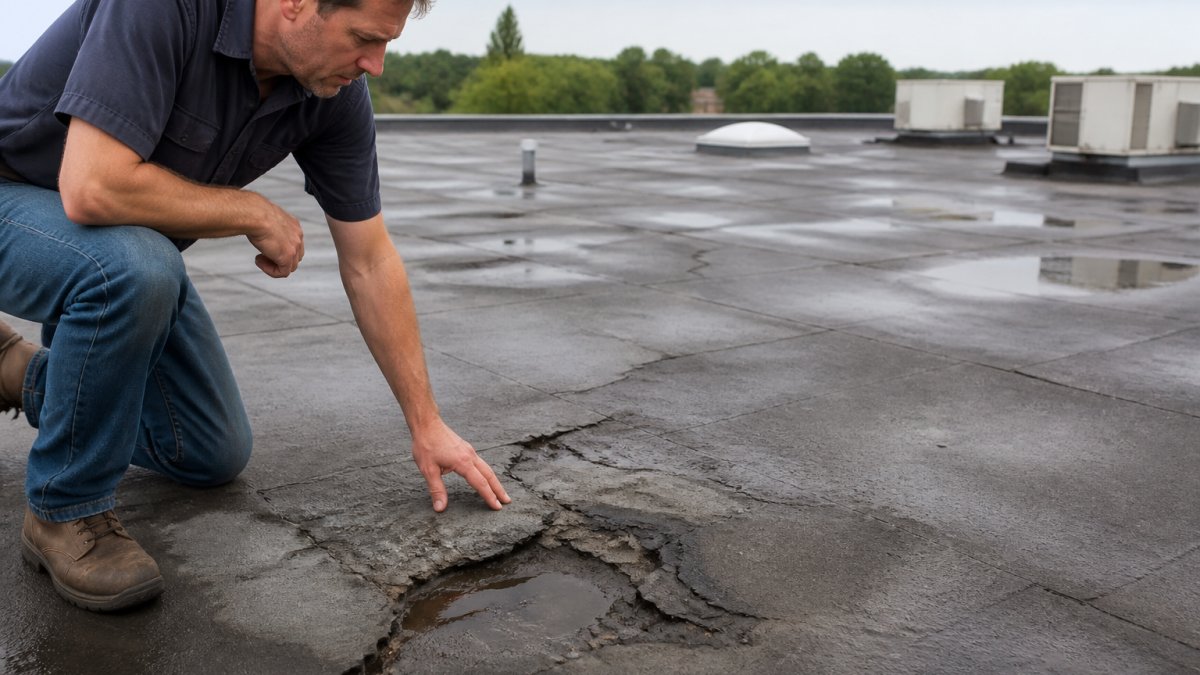
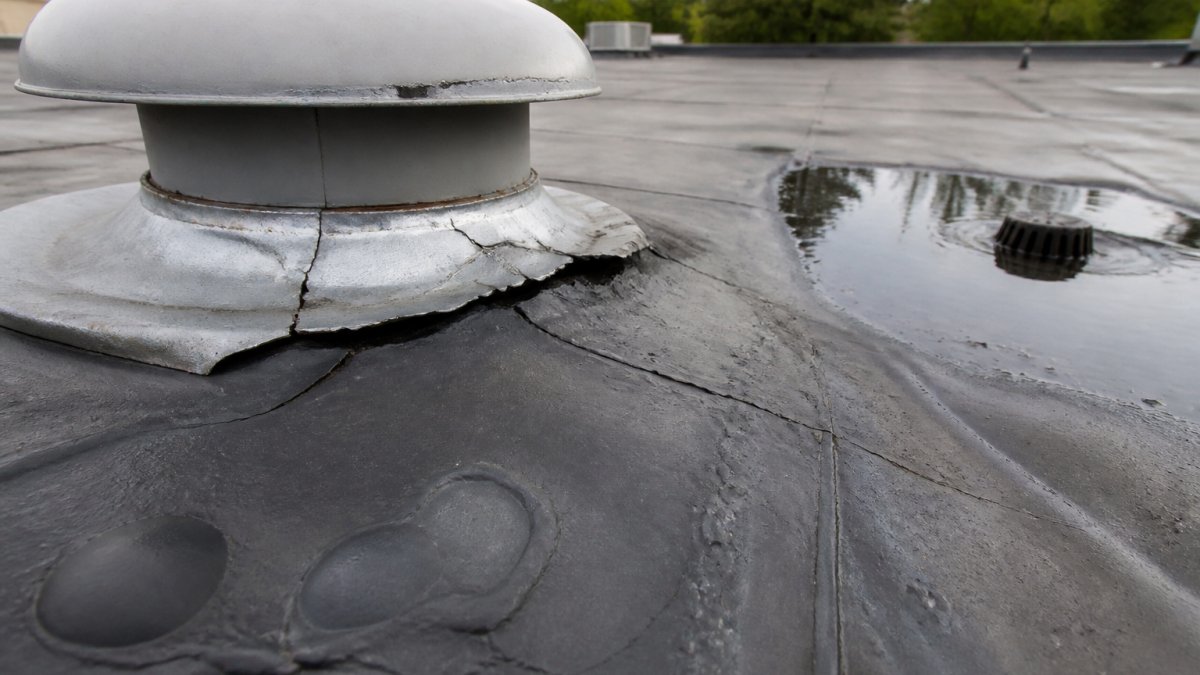
Cracks, blisters, and punctures are physical breaks in the roof membrane, the waterproof layer covering the deck. Blisters look like bubbles or soft raised pockets where trapped moisture has pushed the material apart. Punctures come from foot traffic, dropped tools, or hail. Any of these lets water past the surface into the insulation below. Walk the roof in cool weather and press gently around each blister; if it feels soft or spongy, moisture is already inside.
Damaged or Missing Flashing and Loose Fasteners
Flashing is the metal or membrane sealing the joints where the roof meets walls, vents, curbs, and parapet wall capping. It is the most common leak point on any commercial roof. Look for lifted edges, cracked sealant, rusted screws, and fasteners backing out of the deck. Sealing over failed flashing instead of replacing it is a common mistake; the sealant cracks again within a season.
Ponding Water and Drainage Problems
Ponding water is standing water that remains more than 48 hours after rain. It is a structural warning, not cosmetic: standing water adds weight, accelerates membrane breakdown, and finds every seam failure. Check that drains and scuppers are clear of debris, and look for sagging between supports where water collects. If ponding recurs in the same spot, the roof deck or slope is the real problem, and patching the membrane will not fix it.
Interior Water Stains, Moisture, and Mold
Interior water stains are discolored brown or yellow rings or streaks on ceiling tiles, the clearest proof water is already inside the building. Check the ceiling below roof penetrations, near exterior walls, and around rooftop units. Musty odors, peeling paint, and visible mold or mildew point to long-term moisture rather than a one-time drip. Leaks often travel along decking before appearing, so the stain is rarely directly under the actual breach.
Sagging, Aging, and Storm Damage
Sagging is a visible dip in the roof plane, pointing to structural issues or saturated insulation. Warping at the edges and widespread surface wear usually mean roof aging has caught up with the system. Storm damage, hail damage, and wind damage leave their own signatures: bruised or fractured membrane, displaced ballast, torn edges, and missing shingles on pitched sections.
Your Commercial Roof Inspection Checklist
A commercial roof inspection checklist is a written list of areas and conditions to check during a roof walk, so nothing gets skipped between visits. Use the same list every time and record the date to compare conditions season to season. The list below splits into two tiers: observations any building owner or property manager can safely make from inside or at ground level, and tasks for someone trained and equipped to walk the roof.
Tier 1: Safe Observations From Inside and Ground Level
These require no roof access. Do them monthly and after any major storm.
- Walk the interior perimeter and scan every ceiling tile for brown or yellow rings, streaks, and sagging tiles
- Check ceilings directly below roof penetrations, rooftop units, and exterior walls
- Note musty odors, peeling paint, or visible mold or mildew on upper walls and ceilings
Tier 2: Roof-Access Tasks for a Trained Professional
These involve walking the roof, pressing membrane, or checking fasteners. Building owners should not perform them without fall protection training and the right equipment.
- Walk the full roof surface and scan for cracks, blisters, bubbles, and punctures
- Press test blisters and soft spots to check for saturated insulation
- Inspect flashing at walls, curbs, vents, and parapet wall capping for lifted edges and cracked sealant
Triage: Which Findings Are Urgent
Not every checklist item carries the same weight. Use this three-tier triage to decide how fast to act.
Act today (call immediately):
- Water actively dripping onto electrical panels, server rooms, inventory, or production equipment
- Visible sagging or a dip in the roof plane
- A puncture or open seam during or right before a forecast storm
Schedule an inspection within the week:
- New interior stains that are not actively dripping
- Ponding water that has not drained 48 hours after rain
- Lifted flashing, cracked sealant, or backed-out fasteners
Monitor and document:
- Small surface cracks with no interior symptoms
- Minor granule loss or surface wear on an aging roof
- Isolated ponding that clears within 48 hours
The monitor tier often becomes the schedule tier after the next storm. That is why dated photos and a written log matter: they show whether a condition is stable or progressing.
System-Specific Additions
Add these lines to the checklist based on the roof system on your building.
- Single-ply membrane (TPO, EPDM, PVC): check seams for peeling or fishmouthing, look for punctures from foot traffic, and inspect termination bars at edges
- Metal roof: check for loose or missing fasteners, backed-out screws, seam separation, and rust at panel laps and penetrations
- Built-up roof (BUR) and modified bitumen: check for blisters, alligatoring, bare spots where granules have worn away, and open laps
For a broader look at keeping the whole property in shape, our team maintains a guide to commercial property exterior maintenance tips that pairs well with a roof routine.
Commercial Roof Maintenance Tips That Prevent Costly Repairs
Prevention is mostly housekeeping. The commercial roof maintenance tips below address the causes behind most repair calls, not just the symptoms.
Clear drains and gutters before and after storm season. Trim overhanging branches that drop debris and scrape the membrane.
For a broader look at keeping the whole property in shape, our team maintains a guide to commercial property exterior maintenance tips that pairs well with a roof routine.
Commercial Roof Repair vs Replacement: How to Decide
The commercial roof repair vs replacement question comes down to more than the age of the roofing system. Several factors are typically weighed together: roof age relative to expected service life, how widespread the damage is, whether moisture has reached the insulation, the repair history, and the condition of the system as a whole. A roof with one isolated leak and years of service life left is a repair candidate.
The Five Factors That Drive the Decision
**1.
2. How widespread the damage is. One isolated issue in a defined area is a repair.
3. Whether moisture has reached the insulation. Saturated insulation does not dry out in place on a low-slope roof.
4. Repair history. Repeated repairs in the same area almost always mean the problem is underneath, not on top.
5. System condition beyond the leak. Check the flashing, terminations, drains, and field membrane as a whole.
A Simple Decision Framework
Use this sequence to sort a roof into repair, replace, or assess further.
- Is the leak isolated to one defined area, and is the roof under 50 percent of expected service life? Repair is usually the right call. Get a written scope that addresses the cause, not just the wet spot.
- Is the leak isolated but the roof is over 75 percent of expected service life? Get a full assessment before repairing. A repair may still be correct, but plan and budget for replacement in the near term.
- Are there leaks in multiple areas, soft spots, or recurring stains after patching? Moisture is likely in the insulation. A full assessment, including core cuts or infrared moisture scanning, is the next step. Replacement is often the outcome.
- Is there visible sagging or structural movement? Stop patching. This is an engineering question, not a maintenance question. Have a structural professional evaluate the deck before any repair.
System-Specific Trade-Offs
- Single-ply membrane: isolated punctures and seam failures are highly repairable with patches and seam tape. Widespread seam failure, or membrane that has become brittle, usually points to replacement.
- Metal roof: isolated fastener and sealant failures are routine repairs. Widespread rust-through, seam separation, or panel deformation after a storm is a replacement or retrofit conversation.
- Built-up and modified bitumen: isolated blisters and open laps can be repaired. Alligatoring across the field, bare spots, and saturated insulation across large areas usually mean the system is at the end of its life.
These planning ranges for expected service life help put roof age in context when weighing repair against replacement.
| Roof system | Expected service life |
|---|---|
| Single-ply membrane | Roughly 15 to 20 years |
| Built-up and modified bitumen | 20 to 30 years |
| Standing-seam metal | 30 to 40 years or more |
How to Document Roof Damage Before an Inspection
Documentation turns a vague complaint into a supportable claim or a clear repair scope. Before an inspector arrives, build a simple file:
- Photograph each issue with something for scale, and note the date and location on the roof
- Photograph interior stains and place a bucket or marker to show the drip point
- Write a short description of each symptom and when it first appeared
- Save weather records for any storm you plan to claim
- Keep all prior repair invoices and inspection reports together
An inspector who arrives to dated photos and a written history can give you a faster, more accurate assessment, saving time and usually money.
Request a Free Commercial Roof Assessment
If you have spotted any of the warning signs above, stop guessing and get a professional opinion. Ward's Lawn Care & Landscape Co. has served Greater Cleveland since 1986, and our team provides lawn and landscape maintenance services for residential and commercial properties, with free estimates on every project. When you are ready, contact our team to discuss your property's needs.
Frequently Asked Questions
Can a commercial roof leak without visible water inside?
Yes. Water often travels along the deck or insulation before it reaches an interior surface, so a small membrane breach can go unnoticed for months. Watch for subtler clues: bubbling paint, musty odors, or damp spots near HVAC units. By the time a stain appears on the ceiling, the moisture has usually been present long enough to affect insulation and decking. Regular inspections catch these hidden leaks before interior damage spreads.
How often should a commercial roof be inspected?
Most commercial roofs benefit from an inspection twice a year, ideally in spring and fall, plus after any major hail or wind event. Buildings with heavy foot traffic from HVAC servicing or older membranes may need quarterly checks. A professional commercial roof inspection checklist covers seams, flashing, fasteners, drains, and penetrations, which is where most failures start. Catching issues early keeps small repairs from turning into full replacements.
When should a commercial roof be repaired instead of replaced?
Repair usually makes sense when damage is isolated: a few blisters, a failed seam, or flashing around one penetration. Replacement becomes the better call when the membrane is near the end of its service life, leaks recur across multiple areas, or the deck has sustained structural damage. The commercial roof repair vs replacement decision should rest on the roof's age, the extent of damage, and how often you are paying for fixes that do not hold.
What should you document before contacting your insurance company about roof damage?
Take dated photos of the damage from ground level and on the roof if it is safe, and note the date you first noticed the problem. Save any repair invoices and inspection reports. Keep a written log of leaks, including where water appeared inside. Do not climb onto a damaged roof or move debris before documenting it, and avoid speculating about the cause when you file. A clear record of storm damage or wear helps the adjuster process your claim accurately.
A roof problem rarely announces itself. It shows up as a stain, a soft spot, or water where it should not be. The sooner someone qualified looks at it, the smaller the fix. Ward's Lawn Care & Landscape Co. brings decades of property maintenance experience, highly trained technicians, and free estimates to every assessment. Get started with Ward's Lawn Care & Landscape Co. and protect your building before the next storm season.