 how-to
7 Lawn Fertilizing Mistakes That Wreck Your Grass
Last Updated: October 29, 2026
Quick Summary
Proper lawn fertilizing comes down to four decisions: whether to feed, what to feed, how much, and when. Start with a soil test for lawn fertilizer so you know your pH and nutrient levels before buying product, then apply only when the lawn needs it, at the label rate, and never before wind or rain.
- Apply phosphorus only when a soil test says you need it, per University of Minnesota Extension guidance.
- Cool-season grass is ready to feed when soil at 4 inches holds in the 50s to low 60s.
- Warm-season grasses want feeding once soil reaches 65°F and rising in late spring.
- Calibrate the spreader on a 10-by-50-foot test strip and write the setting on the bag.
- Water lightly after feeding, about a quarter inch, to rinse granules into the root zone.
Table of Contents
- Why Most Lawn Fertilizing Goes Wrong
- Mistake 1: Feeding Without a Soil Test for Lawn Fertilizer
- Mistake 2: Fertilizing at the Wrong Time of Year
- Mistake 3: Guessing at How Much Fertilizer per Square Foot for Lawn
- Mistake 4: Skipping or Botching the Watering Lawn After Fertilizing Step
- Mistake 5: Spreading Fertilizer Unevenly
- Mistake 6: Over-Fertilizing and Burning the Lawn
- Mistake 7: Fertilizing on a Schedule Instead of a Signal
- Frequently Asked Questions
Why Most Lawn Fertilizing Goes Wrong
Most lawns do not fail from neglect. The U.S. Environmental Protection Agency's yard care guidance puts it plainly: apply fertilizer only when the lawn needs it, at the right rate, and never before wind or rain.
Knowing how to properly fertilize a lawn comes down to four decisions: whether to feed, what to feed, how much, and when. Getting those right supports healthier grass.
The same errors show up on small yards and large commercial grounds alike. Below, we walk through the common mistakes and how to fix each one.
Lawn fertilizing is not a seasonal chore. It is a response to what your soil and grass actually need.
Mistake 1: Feeding Without a Soil Test for Lawn Fertilizer
The biggest mistake is feeding blind. A soil test for lawn fertilizer tells you your pH and your nutrient levels before you spend a dollar on product.
Most homeowners skip this step and guess. Then they add phosphorus the lawn never needed, or lime when the soil was already sweet.
What a Basic Soil Test Tells You
A basic test reports three things that change every buying decision:
- pH level: how acidic or alkaline your soil is
- Phosphorus: whether you need any at all
- Potassium and organic matter: what your grass is short on
The University of Minnesota Extension's lawn fertilizing guidance is direct: apply phosphorus only when a soil test says you need it. That advice alone saves money and protects nearby water.
Testing is inexpensive and can be done yourself with a basic kit. How to test soil pH at home walks through five accurate methods.
Mistake 2: Fertilizing at the Wrong Time of Year
Timing decides whether fertilizer feeds grass or feeds weeds. But the calendar most guides hand you is a starting point, not a prescription. The real signal is what the grass and soil are doing right now.
Read the Signal, Not Just the Month
Cool-season grasses, tall fescue, Kentucky bluegrass, perennial ryegrass, do most of their root building when soil temperatures sit in the 50s to 60s and air is cool. That window usually lands in early fall. Warm-season grasses, bermudagrass, zoysia, St. Augustine, wake up later and want feeding once soil has warmed consistently in late spring.
A few practical signals beat any calendar:
- Soil temperature: measure 4 inches down in the morning. Cool-season grass is ready to feed when readings hold in the 50s to low 60s; warm-season grass wants 65°F and rising.
- Growth rate: if you are mowing more than once a week, the lawn is already pushing and does not need a nitrogen boost.
- Color and density: pale, thin turf is a signal to test, not to dump product.
- Weather ahead: the U.S. Environmental Protection Agency's yard care guidance is clear, do not apply before wind or rain. Check the forecast for the next 24 to 48 hours.
The Windows That Actually Matter
For cool-season lawns, the rough rhythm looks like this:
- Early fall: the heaviest feeding, when roots rebuild and top growth slows
- Late spring: a light boost only if the lawn looks pale after green-up
- Summer: skip it in heat and drought, nitrogen pushes soft growth that heat punishes
- Late fall: one final light dose after growth slows but before the ground freezes
Warm-season grasses run on a different clock and want feeding in late spring and summer, tapering off by early fall.
Why the Wrong Window Backfires
Feeding in the wrong window wastes product and stresses the plant. Nitrogen applied right before heat pushes soft top growth with shallow roots. Applied right before frost, it leaves tender blades exposed to cold.
Treat any fertilization schedule as a default, your soil test and your grass should override it.
The article ties each feeding window to what the grass is actually doing, not just the month on the calendar.
| Grass type | When to feed | Key signal |
|---|---|---|
| Cool-season (tall fescue, Kentucky bluegrass, perennial ryegrass) | Early fall is the heaviest feeding | Soil in the 50s to low 60s at 4 inches |
| Cool-season | Late spring, light boost only if pale after green-up | Pale turf after green-up |
| Cool-season | Skip in summer heat and drought | Heat and drought stress |
| Cool-season | One final light dose in late fall | After growth slows, before ground freezes |
| Warm-season (bermudagrass, zoysia, St. Augustine) | Late spring and summer, tapering by early fall | Soil 65°F and rising |
Mistake 3: Guessing at How Much Fertilizer per Square Foot for Lawn
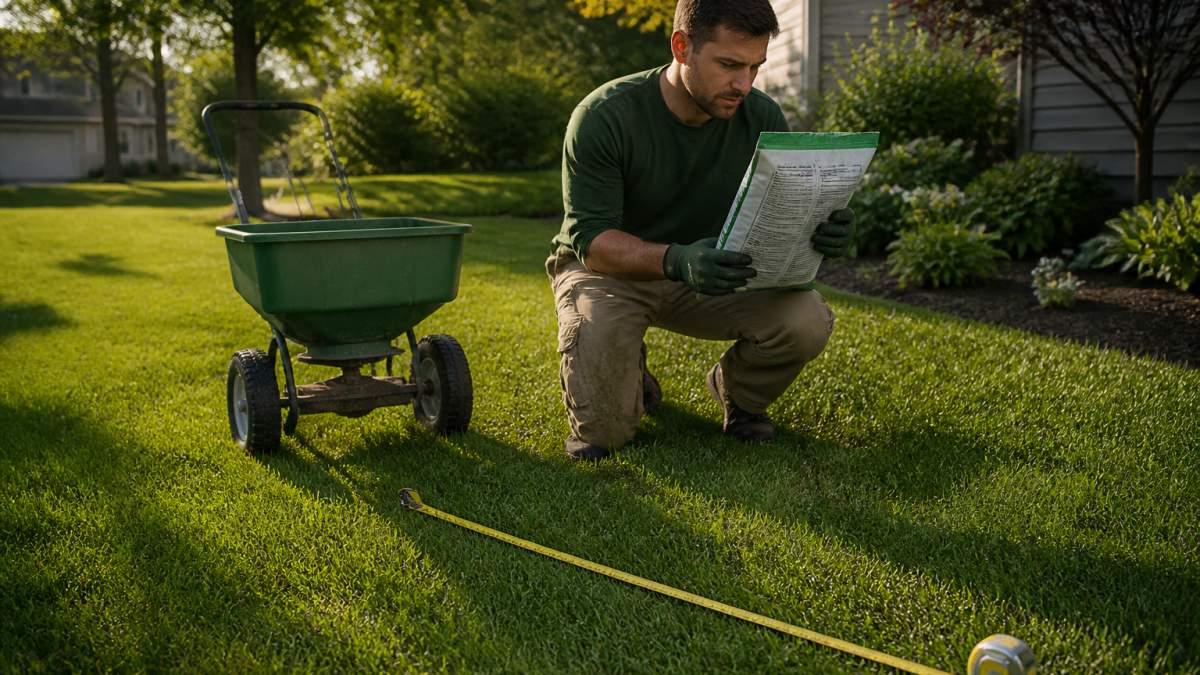
The right rate is set by the bag label, not by feel. How much fertilizer per square foot for lawn comes straight off the nitrogen percentage and your spreader setting, and the spreader setting is where most lawns go wrong.
Reading the Bag Numbers Before You Buy
Every fertilizer bag shows three numbers, like 10-10-10. They mean nitrogen, phosphorus, and potassium, in that order.
Use the label rate. If the bag says one pound of nitrogen per 1,000 square feet, and the bag is 10% nitrogen, you need ten pounds of product for that area.
A common mistake is eyeballing the spreader setting. Set it to the label, then test on a small strip first.
Calibrate the Spreader Before the First Pass
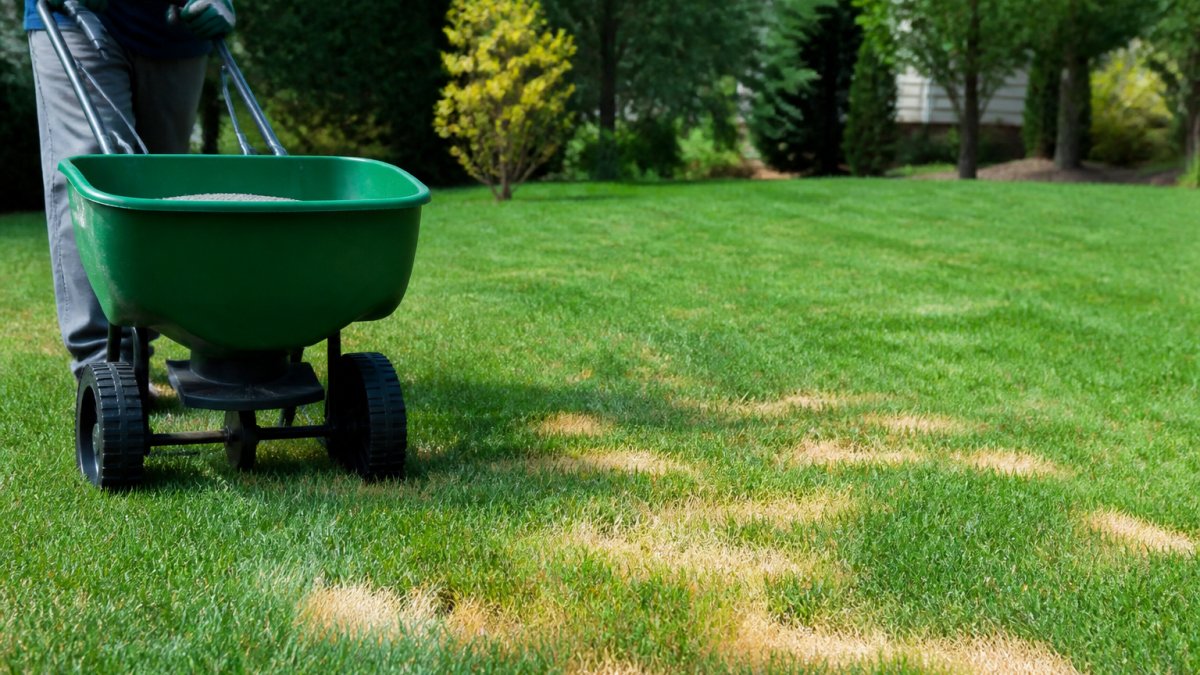
A spreader that is off by a little covers a lot of ground wrong. Calibration is the step most DIY guides skip, and it is the one that prevents streaks and burn.
A simple field calibration:
- Mark a test area. Measure a strip 10 feet wide by 50 feet long, 500 square feet.
- Weigh the product. Fill the spreader with a known weight, then weigh what is left after the pass. The difference is what you applied.
- Do the math. If the label calls for 1 pound of nitrogen per 1,000 square feet and your product is 10% nitrogen, you want 10 pounds of product per 1,000 square feet, so 5 pounds over your 500-square-foot test strip.
- Adjust and repeat. Open or close the spreader setting until the pass delivers the target weight.
Write the setting on the bag with a marker. Next time, you start calibrated.
Troubleshooting a Spreader That Will Not Cooperate
- Streaks: overlap each pass by about a third of the spreader width, and walk in two directions at half rate.
- Heavy lines at turns: close the spreader at every turn and reopen once you are moving.
- Granules in beds and driveways: a broadcast spreader throws wide; a drop spreader keeps the pattern tight but leaves sharp lines if you miss overlap.
- Uneven flow: check for clumps, moisture, or a partially closed gate. Dry product flows more evenly than damp.
Clay soil holds nutrients differently than sandy soil, so product choice matters too.
Mistake 4: Skipping or Botching the Watering Lawn After Fertilizing Step
Watering lawn after fertilizing is what moves nutrients off the surface and into the root zone.
The standard approach is a light watering right after application.
Then watch the weather. The EPA advises against applying fertilizer before rain or wind, so check the forecast first.
Watch out: watering too heavily right after feeding pushes nitrogen past the roots and into groundwater. Light and even beats soaking.
If you use a weed-and-feed product, rain timing gets trickier.
Mistake 5: Spreading Fertilizer Unevenly
Streaky lawns are a spreading problem, not a feeding problem. Uneven passes leave some strips starved and others overloaded.
A few habits fix most of it:
- Split the rate in half and walk the lawn in two directions
- Overlap each pass by about a third of the spreader width
- Keep a steady walking pace and close the spreader at turns
- Calibrate the spreader before the first pass, not after
Drop spreaders avoid drift but leave sharp lines if you miss overlap. Broadcast spreaders cover faster but throw granules into beds and driveways. Pick one and learn its pattern.
Mistake 6: Over-Fertilizing and Burning the Lawn
More fertilizer does not mean greener grass. Over-feeding pushes lush growth, weakens roots, and can scorch the lawn outright.
Burn shows up as straw-colored patches, often in stripes where passes overlapped. It happens when nitrogen hits the grass faster than roots can take it up.
The fix is simple: never exceed the label rate, water lightly after feeding, and skip the application if the lawn is already stressed by heat or drought.
Also resist the urge to feed right after a fresh mow. Give the grass a day to recover.
Mistake 7: Fertilizing on a Schedule Instead of a Signal
A calendar is a starting point, not an order. Fertilize on a signal: soil test results, grass color, growth rate, and the weather ahead.
Lawns tell you what they need. Pale color, slow growth, and thin patches are signals to test, not to dump product. Deep green, steady growth, and a recent feeding mean stop.
This is where most DIY plans fall apart. If you would rather hand off the timing and application, Ward's Lawn Care & Landscape Co. provides lawn and landscape maintenance across Greater Cleveland for homes and commercial properties.
Frequently Asked Questions
Do I really need a soil test before fertilizing my lawn?
Yes, and it saves you money. A soil test for lawn fertilizer tells you which nutrients your grass actually lacks, so you are not paying for phosphorus or lime it does not need. Applying phosphorus only when a soil test shows a need is generally recommended. Test every two to three years, or whenever you see thinning, moss, or weeds spreading. Most county extension offices and garden centers offer basic tests, and the results tell you exactly what to buy.
How much fertilizer should I apply per square foot?
Most lawn fertilizers are applied so you deliver roughly 1 pound of nitrogen per 1,000 square feet per application, which works out to about 0.1 pound of nitrogen per 100 square feet. The exact rate depends on the bag's nitrogen percentage, so divide 100 by the first number on the bag to get the pounds of product per 1,000 square feet. Measure your lawn's length and width first, then set your spreader accordingly and split the dose into two passes at right angles for even coverage.
Should I water my lawn after fertilizing?
Yes. Watering lawn after fertilizing moves the granules off the blades and into the root zone where they can be absorbed. Apply about a quarter inch of water, enough to moisten the top inch of soil without causing runoff. Skip watering if heavy rain is forecast within 24 hours, and never fertilize right before a downpour, since the nutrients will wash straight into storm drains. The EPA also advises against applying fertilizer before windy or rainy days.
Can I fertilize my lawn when it is hot or dry?
Wait. Fertilizing a drought-stressed or heat-dormant lawn pushes new growth the grass cannot support, and the salt in fertilizer can burn already-struggling blades. Water deeply a day or two before you fertilize, and time applications for cooler mornings. In northern Ohio, late summer and early fall are the strongest windows for cool-season grasses, while a light spring feeding is enough to wake the lawn up without forcing excessive top growth.
Feeding a lawn well takes judgment, not just a spreader. If you want the timing, rate, and product handled by technicians who do this every day, Ward's Lawn Care & Landscape Co. is ready. Our crews bring trained eyes, honest recommendations, and free estimates to every property. Get started with Ward's Lawn Care & Landscape Co. and give your grass a season it can actually use.