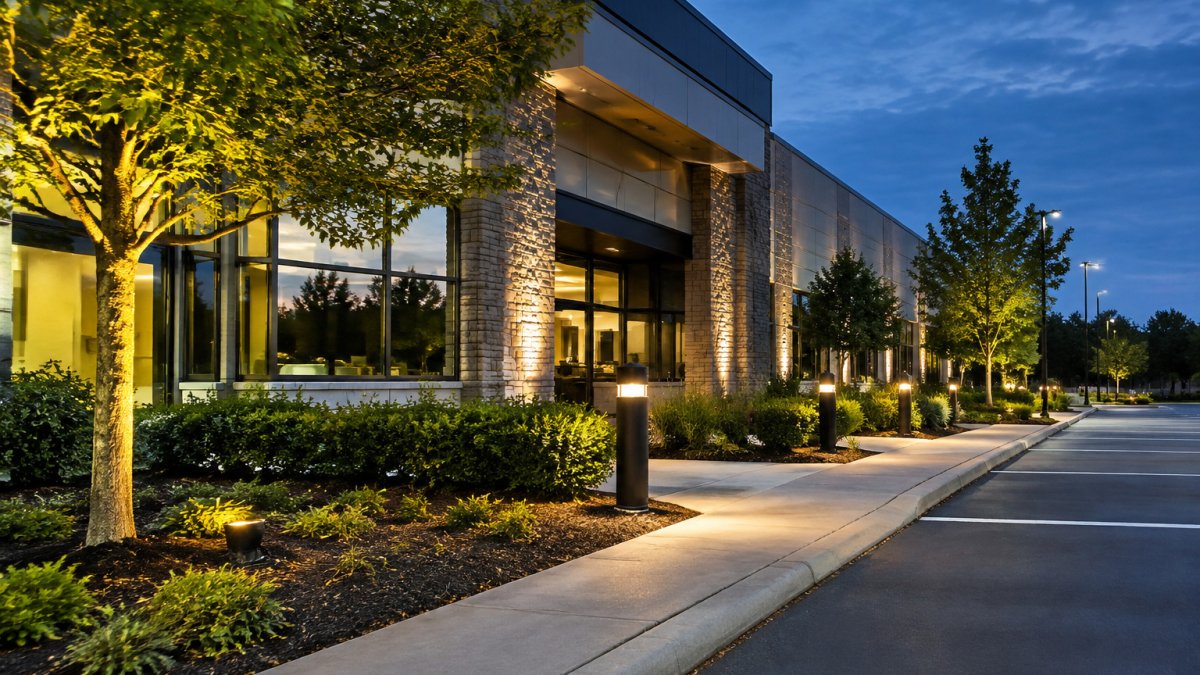
 how-to
How to Choose Commercial Exterior Lighting for Safety
Last Updated: November 5, 2026
Quick Summary
To choose commercial exterior lighting for safety, walk the property at night first and map each zone by use, then match fixture types and mounting heights to parking, entrances, walkways, and loading areas. Set brightness from footcandle targets and uniformity ratios rather than lumens alone, and verify performance with a nighttime commissioning walkthrough.
- OSHA standard 1915.82 requires work areas and walkways to be adequately lighted whenever an employee is present.
- Cooler color temperatures in the 4000K to 5000K range are commonly recommended for parking areas.
- Doubling mounting height roughly quarters the illuminance at the ground for the same output.
- Ask for a point-by-point calculation on the actual site plan before you buy fixtures.
- Run a nighttime commissioning walkthrough within a week of energizing the system and record illuminance readings.
Table of Contents
- Start With a Site Assessment Before You Shop
- Match Fixture Types to Each Area of the Property
- Pick the Right Commercial Parking Lot Lighting
- Use an Outdoor Lighting Lumens Guide to Set Brightness
- Plan Commercial Walkway Lighting That Prevents Falls
- Add Commercial Security Lighting Without the Glare
- Verify Performance After Installation
- Get a Lighting and Grounds Assessment for Your Property
- Frequently Asked Questions
Start With a Site Assessment Before You Shop
The right way to choose commercial exterior lighting for safety starts before you open a catalog. Walk the property at night and write down what you actually see.
Lighting problems on commercial grounds are rarely about brightness. They are usually about dark corners nobody noticed, fixtures blocked by tree limbs, and walkways that go black between poles.
A proper site assessment turns guesswork into a plan. OSHA standard 1915.82 requires employers to keep each work area and walkway adequately lighted whenever an employee is present. That is your legal floor, not your target.
Map the Zones That Need Light
Divide the property into zones and note how each one is used after dark:
- Parking areas and drive lanes
- Building entrances and vestibules
- Walkways, stairs, and ramps
- Loading docks and service areas
- Trash enclosures and storage yards
- Signage and building facades
Mark each zone on a simple sketch. Note the traffic type: vehicles, pedestrians, or both.
Record Mounting Heights and Obstructions
Height drives everything else. Measure or note the mounting height of each existing pole, wall pack, and bollard. Check for tree limbs, signage, and new construction that block light.
This is where a grounds crew and a lighting plan overlap. Our team can walk the property with you and flag landscaping that is shading fixtures or blocking sightlines.
Match Fixture Types to Each Area of the Property
No single fixture covers a whole property. Match the fixture to the job, then check the numbers.
| Area | Fixture Type | Typical Mounting | Key Spec to Check |
|---|---|---|---|
| Parking lot | Area lights on poles | 6-9 m | Beam angle, uniformity |
| Building entrance | Wall lights, sconces | 2.5-3.5 m | Warm color, no glare at eye level |
| Walkway | Bollards, path lights | 0.6-1 m | Low output, even spacing |
| Loading area | Floodlights | 4-8 m | Aim control, cutoff optics |
| Perimeter | Floodlights, wall packs | 3-9 m | Light trespass limits |
Area lights handle open parking and drive lanes. Wall lights mark entrances and doors. Floodlights cover loading zones and perimeter fences. Bollards and path lights guide pedestrians at low height.
Industry guidance on commercial exterior lighting has long pointed to fixture upgrades as a major source of energy savings on commercial sites. Choosing the right type up front is cheaper than replacing the wrong one later.
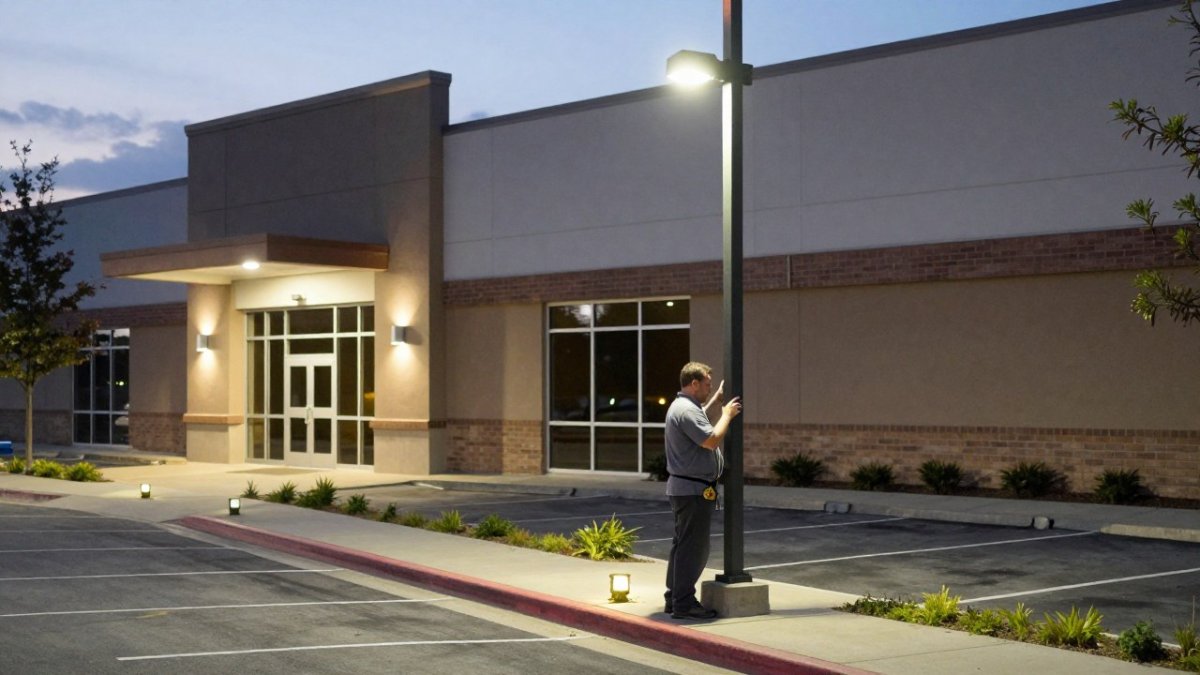
Pick the Right Commercial Parking Lot Lighting
Commercial parking lot lighting is the highest-stakes choice on most properties. It covers vehicles, pedestrians, and the gaps between them.
Start with the fixture, not the wattage. Look for cutoff optics that push light down onto the pavement instead of into the sky or a neighbor's window. Compare beam spread, not just raw output.
Cooler color temperatures in the 4000K to 5000K range are commonly recommended for parking areas because they improve visibility, according to Hevilite's outdoor lighting guidance. Pair that with photocells or timers so lights run only when needed.
Watch out: over-lighting a lot creates glare that hides pedestrians rather than revealing them.
Use an Outdoor Lighting Lumens Guide to Set Brightness
An outdoor lighting lumens guide gives you a starting point, not a final answer. The problem with stopping there is that lumens describe what leaves the fixture, not what lands on the pavement where people walk and drive.
Use these ranges as a first pass:
- Walkways and paths: 300-700 lumens
- Entrances and doorways: 700-1,500 lumens
- Parking areas: 3,000-10,000 lumens per fixture
- Loading and service yards: 5,000-15,000 lumens per fixture
Then convert those numbers into targets you can actually measure. Most practitioners work from maintained horizontal illuminance in footcandles (fc) at the task surface, plus a uniformity ratio, rather than from fixture lumens. A practical, clearly qualified framework looks like this:
- Building entrances and vestibules: roughly 5-10 fc at the door and the first few feet of approach, with a uniformity ratio (max-to-min) no worse than about 4:1 so the door does not become a bright island in a dark wall.
- Walkways, stairs, and ramps: roughly 1-3 fc along the path, with stair treads and ramp edges lit so no single tread falls below about one-third of the brightest tread. Uniformity matters more than raw output here.
- Parking areas and drive lanes: roughly 0.5-2 fc across the lot, with a max-to-min uniformity target in the 4:1 to 10:1 range depending on how the lot is used. Higher-traffic lots should sit at the tighter end.
- Loading docks and service yards: roughly 5-20 fc at the dock face and maneuvering area, because drivers and equipment operators need to judge edges and clearances.
- Perimeter and fence lines: roughly 0.2-1 fc, aimed to reveal movement rather than to flood the fence.
Treat those figures as planning targets, not code. Requirements vary by location and use, and some jurisdictions adopt their own illumination standards or reference recognized recommended-practice documents.
Then adjust for mounting height and spacing. A short bollard throws light a few feet and no further.
The real goal is even coverage, not bright pools with dark gaps between them. Uneven light forces eyes to readjust, and that is where people trip and drivers miss things.
Watch out: sizing fixtures from lumens alone and skipping a photometric layout is the most common way a site ends up over-lit in one zone and under-lit in another.
Plan Commercial Walkway Lighting That Prevents Falls
Commercial walkway lighting exists to prevent trips and falls. Steps, curb edges, and changes in surface are where people get hurt.
Keep bollards and path lights low and evenly spaced. Aim for continuous light along the path, not spotlights at intervals. Light every stair tread and ramp edge clearly.
Warmer light reads as welcoming and casts softer shadows at ground level.
Research on ambient lighting and perceived safety suggests better ambient lighting leads people to feel safer outdoors in their community. Feeling safe matters, because a well-lit path gets used.
Lighting also supports curb appeal. Our guide to maintaining curb appeal covers how exterior details, lighting included, shape how a property reads from the street.
Add Commercial Security Lighting Without the Glare
Commercial security lighting fails when it blinds instead of reveals. A wall of white light on a facade looks secure but can wash out faces and hide movement in the shadows.
Layer your security lighting:
- Perimeter floodlights with tight beams aimed at fences and gates
- Wall packs at service doors and alleys
- Motion sensors for low-traffic areas
- Photocells and timers so lights behave the same every night
Keep light on your property. Aim fixtures down and inward, and shield them so they do not spill onto roads or neighboring buildings.
Verify Performance After Installation
A finished install is not a finished job. Commissioning is the step that turns a lighting plan into a system that actually works, and it is the step most projects skip. Check the system at night, on foot, the way a visitor would use it, and document what you find.
Run this sequence after dark, ideally within a week of energizing the system:
- Nighttime walkthrough. Walk every path, lot, and service area in the order a visitor would use them. Note dark gaps, hot spots, and any place where your eye has to readjust sharply.
- Aim and adjust. Confirm each floodlight and adjustable fixture points where the plan intended. Fixtures drift during installation and shipping, and a flood aimed a few degrees off can throw glare into a window or leave a gate in shadow.
- Sensor and control testing. Trigger every motion sensor, photocell, and timer manually. Confirm the on/off thresholds, delay times, and override behavior match the schedule. Test the failure mode too: what happens when the photocell is covered or the network drops.
- Glare and trespass check. Stand at each entrance and look outward at eye level. If you see the source of a fixture rather than the surface it lights, it needs shielding or re-aiming. Walk the property line and confirm light stays on your side.
- Measure and record. Take illuminance readings at the task surfaces named in the plan, at the same points used for the design calculation. Record the values and the date. This gives you a baseline to compare against later.
- Document. Photograph each zone, note fixture types and aim settings, and file the readings with the as-built drawings. Maintenance crews change, and the documentation is what keeps the next person from guessing.
A short nighttime walk twice a year catches most problems after commissioning. Fixtures drift out of aim. Trees grow into sightlines. Bulbs fail one at a time. Lenses haze over, and lumen depreciation quietly erodes the safety margin you designed in.
Watch out: commissioning in daylight or skipping the measured readings leaves you with no way to prove the system performs as designed, and no baseline to show when it has degraded.
Visibility into performance is what keeps a plan working, and commissioning is how you establish that visibility in the first place.
Get a Lighting and Grounds Assessment for Your Property
Lighting does not work alone. It works with the grounds around it, and that is where we come in.
If your property has dark walkways, glare problems, or fixtures hidden behind overgrown trees, start with an assessment. Our team can review your commercial grounds services and contact you about the details of a lighting and grounds walkthrough.
Our commercial groundskeeping guide explains the full scope of what ongoing exterior care covers.
Frequently Asked Questions
How many lumens do commercial outdoor lights need?
There is no single number, but 700 lumens is a common baseline for outdoor LED fixtures, and requirements rise with traffic and task. Parking lots generally need more delivered light than a quiet walkway, and the number that matters is illuminance at the surface, measured in foot-candles, not the lumen rating on the box. Compare beam spread and mounting height before choosing output, because a wide beam at the wrong height wastes light and creates glare.
What color temperature works best for commercial exterior lighting?
Warm light in the 2700K to 3000K range suits hospitality spaces and pedestrian areas where people linger, while cooler 4000K to 5000K light improves visibility in parking lots and roadways. Keep one consistent temperature across connected areas so eyes do not have to readjust. Mixing warm entrance lighting with cool lot lighting on the same property is a common mistake that makes both look dimmer than they are.
How should commercial security lighting be placed to reduce glare and dark spots?
Aim fixtures so the light lands on the ground and walkable surfaces, not into a driver's or pedestrian's line of sight. Space poles and wall lights so pools of light overlap rather than leaving gaps between them. Use photocells, timers, or motion sensors to keep coverage consistent through the night, and check uniformity after dark, since a bright fixture beside a dark patch can make the dark area harder to see than no light at all.
What does OSHA require for exterior lighting on a commercial property?
OSHA Standard 1915.82 requires employers to keep each work area and walkway adequately lighted whenever an employee is present. Those rules set a floor for employee safety, not a full design plan, so most property managers pair them with photometric planning and a post-installation walkthrough after dark.
A property that looks safe after dark gets used, leased, and trusted. Ward's Lawn Care & Landscape Co. has served Greater Cleveland since 1986 with full-service outdoor maintenance and landscape construction, free estimates, and discounts when you hire us for multiple services. Get started with Ward's Lawn Care & Landscape Co. and see your property in a better light.