 ultimate-guide
Residential Lawn Mowing Service Cost: A 2026 Pricing Guide
Table of Contents
- What Drives the Price of a Lawn Mowing Service?
- Average Lawn Mowing Price Per Square Foot vs. Per-Visit Rates
- How Lawn Mowing Service Frequency Changes Your Total Cost
- What's Included in a Standard Residential Mowing Visit?
- Additional Services That Add to the Bill
- Contract vs. On-Demand: Which Pricing Model Fits Your Yard?
- How to Avoid Surprise Landscaping Costs Before You Hire
- Frequently Asked Questions
Last Updated: September 6, 2026
The residential lawn mowing service cost is rarely a single, simple number you can find online and take to the bank. Instead, it is the product of several variables, including your property's square footage, the frequency of visits, the specific services bundled into each stop, and the labor market in your specific region. This guide breaks down those variables so you can build an accurate budget and avoid the surprise charges that often appear on the final invoice.
Most homeowners make one critical mistake when researching lawn care: they search for a national average and assume it applies to their yard. That approach fails because a quarter-acre lot with steep slopes and mature landscaping requires a different level of effort than a flat, half-acre lot with open grass. Below, we'll show you exactly how to calculate your own cost estimate, what to expect from a standard service package, and the questions to ask before you sign a contract.
What Drives the Price of a Lawn Mowing Service?
Several factors combine to determine your final price, but the most significant is the size of your property. A larger yard requires more time, more fuel, and more wear on professional equipment, so providers scale their per-visit rates accordingly. Your acreage and lot size directly influence how long a crew needs to be on your property.
Terrain and layout matter almost as much as raw size. A yard with steep slopes and uneven terrain slows down a mowing crew and increases the physical demands of the job. Similarly, a property with intricate landscaping beds, narrow gates, or obstacles like trees and garden structures requires careful maneuvering that adds time to every visit.
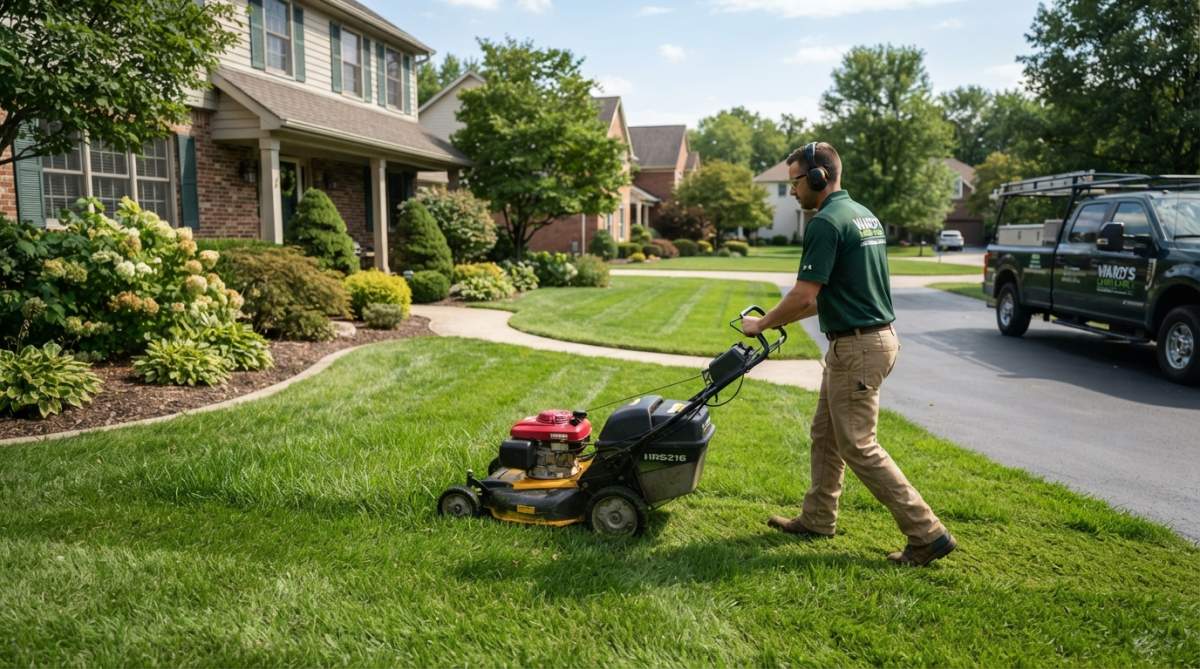
Your property's location also plays a role. Labor costs vary significantly from one metro area to another, and even within a single region, providers in higher-cost neighborhoods often charge more to cover their own operating expenses. This regional labor market impact is one of the most underappreciated factors when homeowners compare their bill to a friend's in another state.
Average Lawn Mowing Price Per Square Foot vs. Per-Visit Rates
Lawn care providers typically quote prices in one of two ways: a flat per-visit rate or a price based on your lawn's square footage. The average lawn mowing price per square foot is more common for larger commercial properties, while residential customers usually see a flat per-visit rate that reflects the estimated time and effort for their specific yard (extension.org).
Per-visit rates are the standard for residential properties because they are simple for the homeowner to understand and for the provider to quote. A provider assesses your yard, estimates the time required, and gives you a single number for each service call. This approach works well for standard service packages, but it can become confusing when you add extra services like edging or debris removal.
To give you a sense of the market, several national booking platforms publish starting rates for mowing visits. These figures are for baseline service on a relatively small, accessible lawn; your actual quote will depend on the specifics of your property.
| Service Model | Starting Price | Best For | Key Trade-off |
|---|---|---|---|
| GreenPal marketplace | ~$30 per visit | Comparing multiple local quotes | Price varies by vendor availability |
| LawnStarter platform | ~$42 per visit | Bundled services beyond mowing | Add-ons scale the price quickly |
| LawnGuru on-demand | ~$38 per visit | One-time cuts, no contracts | Depends on local contractor density |
| Lawn Love platform | ~$30 per visit | Instant remote quotes | Quality varies by local contractor |
How to Measure Your Lawn's Square Footage
To compare quotes accurately, you need to know your lawn's actual size. Measure the length and width of your grass areas in feet, multiply them to get the square footage, and subtract any areas that are not grass, such as your house, driveway, or patio. For irregular shapes, break the yard into rectangles and triangles, calculate each section, and add them together.
Many online mapping tools let you trace your property lines and calculate square footage without stepping outside. This measurement gives you a concrete number to share with providers, which makes quote estimation far more accurate. A provider who knows your yard is 5,000 square feet can give you a precise number rather than a range based on guesswork.
How Lawn Mowing Service Frequency Changes Your Total Cost
Your choice between weekly mowing and bi-weekly service has a direct impact on both your per-visit rate and your total seasonal spending. Providers often charge a higher per-visit rate for bi-weekly service because the grass is longer, takes more time to cut, and produces more grass clippings to manage.
Weekly mowing keeps grass at a consistent height, which means each visit is faster and requires less effort. Many providers offer a slight discount for weekly service because the predictable schedule lets them optimize their routes and reduce fuel costs. Bi-weekly service, by contrast, means the crew spends more time on your lawn each visit, often raising the per-visit rate to compensate.
The right service frequency depends on your grass type, the season, and your expectations for lawn health. During peak growing months, weekly mowing keeps your yard looking sharp and prevents the grass from becoming stressed. In slower seasons, bi-weekly service is often sufficient to maintain a healthy lawn without unnecessary expense.
What's Included in a Standard Residential Mowing Visit?
A standard residential mowing visit typically includes cutting the grass to the proper height, trimming around edges and obstacles, and blowing clippings off hard surfaces like driveways and walkways. The specific tasks can vary by provider, so it is essential to ask what is included in the quoted price before you hire anyone.
Most standard service packages cover the basics: mowing the main lawn area, trimming grass along fences and beds, and a basic cleanup of grass clippings. Some providers include edging along sidewalks and driveways as part of the standard visit, while others treat it as an add-on service. Clarify this distinction up front, because edging is one of the most common sources of surprise charges.
Debris removal is another point of confusion. If a storm leaves branches or leaves on your lawn, some providers will remove them as part of the visit and others will charge extra. Ask your provider how they handle yard cleanup and whether seasonal debris is included in your service contract or billed separately.
The quality of the cut also depends on the provider's professional equipment. Commercial mowers produce a cleaner cut than residential machines, which supports better lawn health and a more polished appearance (extension.psu.edu). When you are comparing quotes, ask what type of equipment the crew uses and whether the mower blades are sharpened regularly.
Additional Services That Add to the Bill
Beyond basic mowing, most providers offer a range of add-on services that improve your lawn's appearance and health. These services each carry their own price and can significantly increase your total bill if you add several at once.
Fertilization programs are a common add-on that supports lawn health and color throughout the growing season. Weed control is often bundled with fertilization, since a healthy, dense lawn naturally suppresses weeds. If you have a persistent weed problem, a dedicated treatment program may be more effective than spot-treating individual weeds yourself.
Seasonal maintenance tasks like aeration and overseeding are typically quoted as separate services. Aeration removes plugs of soil to reduce compaction and let water and nutrients reach the roots (extension.umn.edu). Overseeding fills in thin areas and improves the density of your lawn. Both are valuable for long-term lawn health but add to your annual lawn maintenance budget.
Other services, such as curbside leaf cleanup in the fall or spring yard cleanup, are almost always billed separately from routine mowing. These jobs require different equipment and significantly more labor than a standard mowing visit. Bundling multiple services with a single provider can unlock discounts, which is a practical way to manage your total spending.
Contract vs. On-Demand: Which Pricing Model Fits Your Yard?
The decision between a recurring service contract and on-demand bookings comes down to your priorities for consistency, convenience, and cost. A service contract locks in a regular schedule with a dedicated provider, which ensures your lawn is maintained consistently throughout the growing season.
Contract pricing is often more favorable per visit than on-demand rates because the provider can plan their routes and schedule with certainty. This predictability lets them operate more efficiently, and they typically pass some of those savings on to you. A contract also means you do not have to remember to book each visit or worry about availability during peak season.
On-demand service gives you flexibility to book a cut only when you need it. This model suits homeowners who travel frequently, have inconsistent schedules, or only need occasional help during peak growing periods. The trade-off is that per-visit rates are often higher, and you risk finding no availability during the busiest weeks of the season.
For most homeowners with a standard residential property, a service contract with a local provider is the more cost-effective and reliable choice. The consistency of weekly or bi-weekly visits keeps your lawn healthier, and the predictable schedule eliminates the hassle of last-minute booking.
How to Avoid Surprise Landscaping Costs Before You Hire
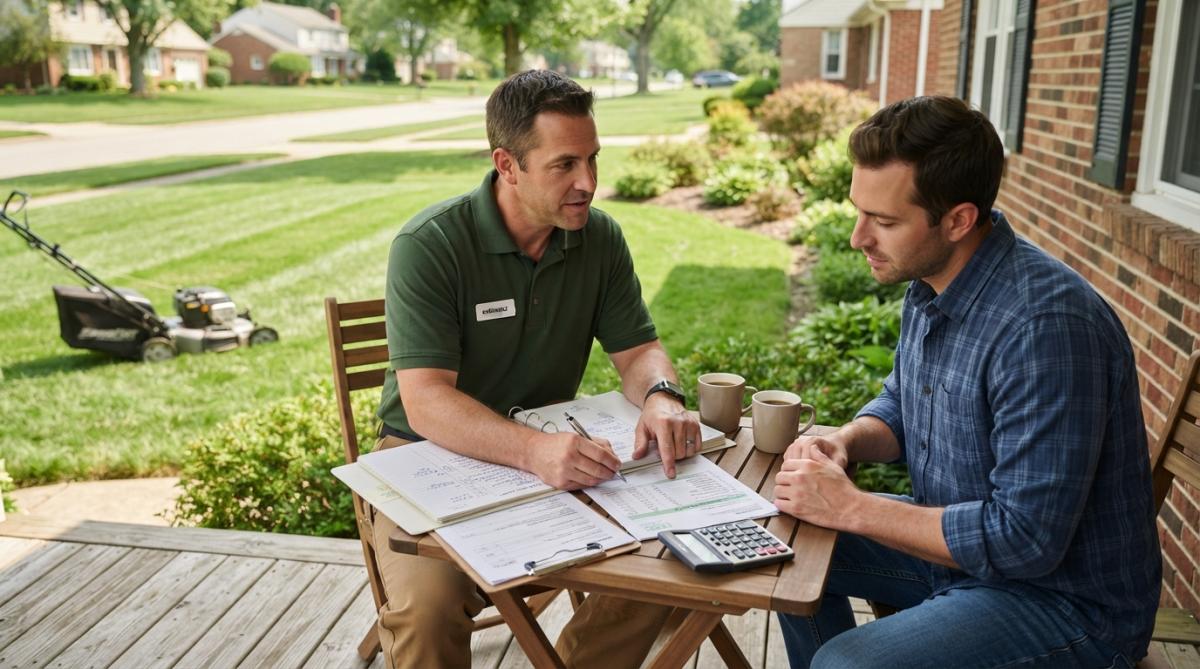
The best way to avoid surprise landscaping costs is to ask the right questions before you sign anything. Every reputable provider should be willing to explain exactly what is included in their quoted price and what services are billed separately.
Start by requesting a written quote that itemizes the services included in each visit. Ask specifically about edging, trimming, and blowing, and confirm whether grass clippings are removed or left on the lawn. Ask about fuel surcharges, which some providers add when gas prices spike, and whether there are any fees for properties with difficult access.
Verify that the quote is based on a site visit or an accurate measurement of your property, not a guess from a phone call. A provider who quotes you a price without seeing your yard is likely to adjust the price upward once they arrive. Finally, ask about their policy for long grass or overgrown lawns, since some providers charge a restoration fee if the grass has been neglected.
A local provider with a long track record is often a safer bet than a national platform with rotating contractors. Ward's Lawn Care & Landscape Co. has served Greater Cleveland since 1986, offering free estimates and comprehensive outdoor maintenance. Our highly trained technicians handle everything from routine mowing to full landscape construction, and we offer discounts when you bundle multiple services. If you are tired of inconsistent service and surprise charges, contact Ward's Lawn Care & Landscape Co. for a free estimate and see what dependable, professional results look like.
Frequently Asked Questions
Is $50 for lawn mowing good?
Whether $50 is a fair price depends entirely on your lot size, the lawn mowing service frequency you need, and your local market. For a smaller suburban yard, a $50 per-visit rate might be on the higher end. For a larger property with obstacles or slopes, that same $50 could be a bargain. The most accurate way to know if a quote is competitive is to get free estimates from local providers and compare what each one includes in their standard service package.
Does lawn size significantly impact mowing service quotes?
Yes, lawn size is the single biggest factor in a mowing quote. Providers often price by estimated time or by applying an average lawn mowing price per square foot to your property's dimensions. A smaller lot might take 30 minutes, while a half-acre property could take over an hour. When you request a quote, be ready to share your yard dimensions or an address that allows the provider to measure your lot accurately.
What is the 1/3 rule for mowing?
The 1/3 rule is a lawn health guideline that says you should never remove more than one-third of the grass blade's height in a single mowing. Cutting too much at once stresses the lawn and can leave it vulnerable to weeds and disease. This rule is why lawn mowing service frequency matters: during peak growing season, weekly mowing is often necessary to keep grass at a healthy height without scalping it.
What additional services are typically bundled with lawn mowing?
Most standard service packages include mowing the front and back yard, trimming around edges and obstacles, and blowing clippings off hard surfaces. Many homeowners add fertilization, weed control, and seasonal cleanup as separate services. Because a technician is already at your property, bundling these extras often costs less than hiring separate providers, and it can also qualify you for a multi-service discount.
Budgeting for lawn care does not have to be a guessing game. The residential lawn mowing service cost for your property depends on its size, terrain, your chosen service frequency, and the specific services you need. By measuring your lawn, asking the right questions, and choosing a provider who is transparent about pricing, you can keep your yard healthy without blowing your budget. Get started with Ward's Lawn Care & Landscape Co. and request your free estimate today.