 how-to
Preventing Grass Clippings on Hardscaping: 7 Steps
Table of Contents
- Why Clippings End Up on Hardscaping (and What It Costs You)
- Lawn Mower Chute Blockers and Rubber Flaps That Actually Work
- Best Mower Discharge Patterns for Driveways and Walkways
- Mowing Frequency, Grass Height, and Wet Grass Tactics
- Mulching vs. Bagging: Which Keeps Hardscaping Cleaner?
- How to Clean Grass Off Pavers, Concrete, and Decorative Stone
- Preventative Landscaping Design and Your Post-Mowing Schedule
- Frequently Asked Questions
Last Updated: September 14, 2026
Why Clippings End Up on Hardscaping (and What It Costs You)
Preventing grass clippings on hardscaping starts with understanding why they land there in the first place. A mower deck doesn't scatter clippings randomly. It throws them in a predictable arc based on discharge direction, blade speed, and how much grass you're cutting at once. Point that arc toward a driveway, and you've got a mess before you've finished the first pass.
The cost isn't just aesthetic. Wet clippings stain concrete and leave tannin marks on pavers that set in within hours. They wash into storm drains, carrying nitrogen-rich residue into local waterways. And they create slick, dangerous surfaces on walkways and patios.
Ward's Lawn Care & Landscape Co. has observed homeowners facing this challenge every mowing season. The fix isn't one trick. It's a combination of equipment setup, mowing technique, and a maintenance routine that keeps hardscaping clean without extra work.
Below, we'll walk through seven steps that actually work, from chute blockers to post-mowing schedules. EPA guidance on yard waste and stormwater runoff
Lawn Mower Chute Blockers and Rubber Flaps That Actually Work
A chute blocker is a plate or flap that covers the mower's side discharge opening, forcing clippings down into the turf instead of out across your driveway. Rubber flaps work the same way: they hang over the discharge chute and deflect clippings downward.
The common mistake is buying a universal flap and bolting it on without checking clearance. A flap that sits too low drags on uneven ground and tears within a season. One that sits too high does nothing.
What works better:
- Adjustable chute blockers that let you close the discharge entirely for perimeter passes
- Heavy rubber flaps (at least 3-4 mm thick) mounted so the bottom edge sits 1-2 cm above the deck
- Mulching kits that replace the discharge chute with a recirculating baffle, eliminating side ejection altogether
If you're running a mulch kit, you won't need a flap. But mulch kits reduce cutting capacity in tall or wet grass, which brings us to the next trade-off.
Best Mower Discharge Patterns for Driveways and Walkways
The best discharge pattern for keeping hardscaping clean is simple: mow with the discharge chute pointed away from pavement on every pass. That sounds obvious, but most people mow in a fixed direction and never adjust.
Here's the pattern that works:
- Perimeter pass first. Run one full lap around the lawn's edge with the chute facing inward, toward the grass.
- Back-and-forth passes. Alternate direction so clippings from each pass land on already-cut turf, not on pavement.
- Final blow-off pass. Make one slow pass along the hardscape edge at reduced speed. Lower mower speed reduces clipping velocity and throw distance.
Mower speed matters more than most people realize. Running at full throttle throws clippings 1-2 meters further than a moderate pace. For edges and tight spaces, drop to half speed.
Mowing Frequency, Grass Height, and Wet Grass Tactics
Mowing more often is the single most effective way to reduce clipping volume. The "one-third rule" applies here: never remove more than one-third of the grass blade height in a single cut (extension.psu.edu). Cut more than that, and you produce long, heavy clippings that clump and scatter.
| Grass Condition | Mowing Frequency | Deck Height | Clipping Volume |
|---|---|---|---|
| Fast growth (spring) | Every 5-7 days | 3-3.5 inches | Moderate |
| Normal growth | Every 7-10 days | 3 inches | Low |
| Slow growth (summer) | Every 10-14 days | 3.5-4 inches | Low |
| Wet grass | Wait until dry | Raise 1/2 inch | High (avoid) |
Wet grass is the worst-case scenario. Clippings stick to mower decks, clump on hardscaping, and stain concrete. If you must mow wet grass, raise the deck height by half an inch and plan to make a second pass once it dries.
Mulching vs. Bagging: Which Keeps Hardscaping Cleaner?
Bagging keeps hardscaping cleaner in the short term. Mulching keeps it cleaner in the long term, provided you stay under the one-third rule and keep the deck clean. The hardscape-specific wrinkle most guides skip is staining: mulched clippings that land on porous stone or unsealed concrete release grass juice, and that juice is what leaves the brown-green marks you can't blow off.
Here's the mechanism. When a mulching blade chops a grass blade, it ruptures the cell walls and releases sap. Fresh sap on a paver or concrete surface oxidizes within a few hours and bonds to the calcium in the stone. Blowing removes the dry clipping but not the stain. That's why "I blew it off right after mowing" doesn't always save the driveway.
Bagging sidesteps the problem because nothing hits the pavement. The trade-offs are real: you stop to empty the bag every few passes on a large lawn, you remove nitrogen the turf would otherwise recycle, and bagged clippings have to go somewhere, compost pile, municipal yard-waste program, or the trash.
Mulching sidesteps the bagging chore but only works if three conditions hold:
- You're cutting less than one-third of the blade height. More than that and the clippings are too long to sift down between grass blades. They sit on top, dry into clumps, and the next breeze or mow sends them onto the hardscape.
- The grass is dry. Wet clippings mat together and stick to the deck and the pavement. Mulching wet grass is the fastest way to coat a driveway in green paste.
- The deck is clean underneath. A packed deck drops clumps at the start of every pass, usually right where you turned, often on the driveway apron.
The practical decision rule most lawn-care crews use: mulch during normal and slow growth, bag during the spring flush, after any mow where you're cutting more than a third of the blade, and any time the grass is wet enough to clump. If you're hiring out the work, ask which method the crew uses and whether they switch based on conditions, a crew that mulches year-round on a fast-growing spring lawn is a crew that will stain your pavers.
If you mulch and a stain does land on porous stone, treat it the same day. A 1:1 mix of water and white vinegar, applied with a soft brush and rinsed, lifts fresh grass stains from unsealed concrete and most pavers. Sealing the hardscape before mowing season starts is the longer-term fix, a penetrating sealer keeps the sap out of the pores in the first place.
How to Clean Grass Off Pavers, Concrete, and Decorative Stone
Most guides stop at "grab a blower and sweep." That works on a smooth concrete driveway and fails everywhere else. Pavers, stamped concrete, exposed-aggregate finishes, and loose decorative stone each trap clippings differently, and the wrong tool scratches the surface or drives debris deeper into the joints.
Match the tool to the surface before you start:
| Surface | First tool | Finish tool | Avoid |
|---|---|---|---|
| Broom-finished concrete | Backpack blower, flat nozzle | Stiff-bristle push broom | Pressure washing at high PSI near control joints |
| Clay or concrete pavers | Backpack blower, rubber-tipped nozzle | Soft-to-medium push broom | Metal rakes and wire brushes that gouge the chamfer |
| Stamped or stamped-overlay concrete | Backpack blower on low throttle | Soft-bristle push broom | Stiff bristles that dull the release-agent finish |
| Exposed-aggregate concrete | Backpack blower, wide fan nozzle | Soft push broom | Pressure washing that dislodges the aggregate |
| Loose gravel or river rock | Backpack blower on low throttle | Gentle hose rinse | Pressure washing that rearranges the stone bed |
| Permeable pavers | Backpack blower | Soft broom | Sweeping joint aggregate out of the openings |
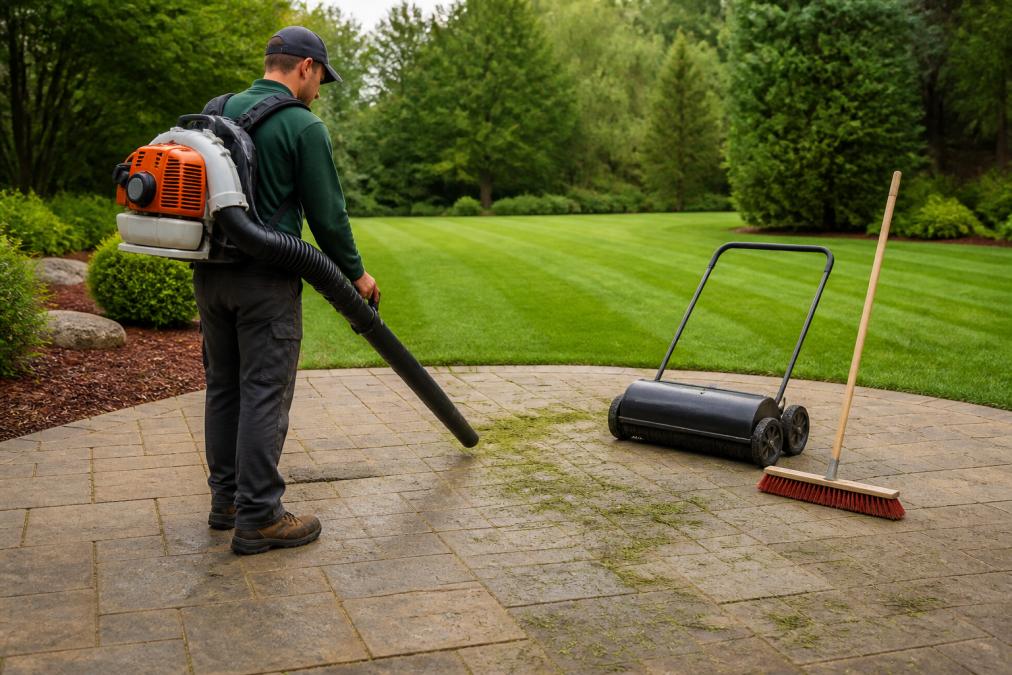
A rubber-tipped blower nozzle is the single most useful hardscape accessory. It keeps the metal tube off the paver face, so a slip doesn't leave a scratch line across a $4,000 patio. A wide fan nozzle spreads the air stream and moves clippings without blasting joint sand out of the gaps.
A push sweeper, the walk-behind, rotary-brush type sold for shop and garage use, is the tool most homeowners don't think to bring outside. On long driveways and wide patios it picks up dry clippings in one pass instead of pushing them into a pile you then have to scoop. It's slower than a blower on open concrete but faster and cleaner on paver joints, where a blower tends to bury debris.
The step-by-step process:
- Blow first, sweep second. Start at the highest point of the hardscape and work downhill, pushing debris toward the lawn or a tarp. A backpack blower moves more material faster than a broom, but only if you keep the nozzle 12-18 inches off the surface, closer than that and you're just stirring dust.
- Sweep the joints. Paver joints and stamped-concrete grooves trap clippings that a blower can't lift. A soft-to-medium push broom pulls them out without disturbing polymeric sand or joint aggregate. Work perpendicular to the joint lines so you're lifting debris out, not packing it in.
- Trim the lawn edge. Use a string trimmer to knock down grass overhanging the hardscape edge. Do this after blowing, not before, or you'll just add fresh clippings to a surface you already cleaned.
- Rinse decorative stone gently. Loose gravel and river rock need a low-pressure hose rinse, not a pressure washer, which displaces the stones and exposes the weed barrier underneath.
- Compost or bag the debris. Don't blow clippings into the street. They wash into storm drains and contribute to nutrient runoff. EPA guidance on yard waste and stormwater runoff
Preventative Landscaping Design and Your Post-Mowing Schedule
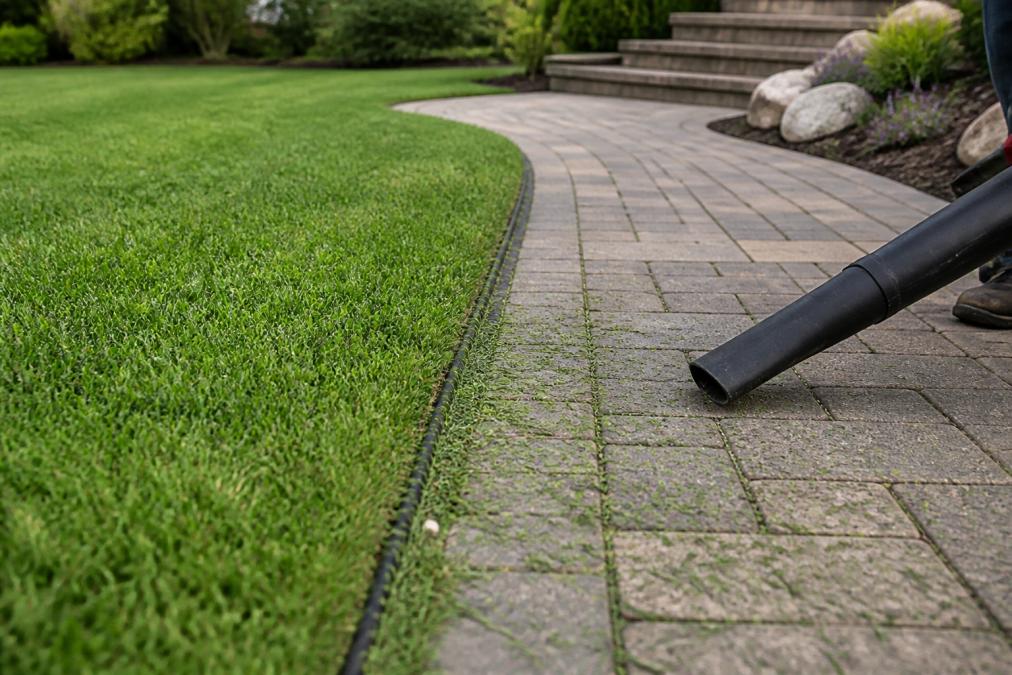
Preventative landscaping design solves the problem before it starts. A 6-12 inch strip of mulch or groundcover between the lawn and the hardscape acts as a buffer. Clippings land in the bed instead of on the pavement, and the bed is easier to clean.
Design changes that reduce clipping scatter:
- Mulch beds along driveways and walkways
- Edging (steel or concrete) to create a clean line between turf and hardscape
- Groundcover like creeping thyme or sedum in tight spaces where mowing is difficult
- Rubber flaps on mower decks for existing lawns
Your post-mowing maintenance schedule should include:
- Blow hardscaping immediately after mowing, before clippings dry
- Check and clear mower deck after each use
- Sharpen blades every 20-25 hours of use
- Inspect chute blockers and flaps for wear monthly
- Rinse decorative stone every 2-3 mowings
Blade sharpness deserves its own mention. Dull blades tear grass instead of cutting it, producing ragged clippings that clump and scatter more easily. Sharp blades also reduce fuel consumption and disease risk in turf.
For homeowners who'd rather not manage all of this themselves, Ward's Lawn Care & Landscape Co. offers full-service lawn maintenance and landscape construction throughout Greater Cleveland. Our technicians are highly trained and deliver professional results, including routine lawn care and fertilization, which helps keep hardscaping clean.
Keeping grass clippings off hardscaping comes down to equipment setup, mowing technique, and a consistent cleanup routine. Get the discharge pattern right, add a chute blocker or mulch kit, and blow the pavement immediately after each mow. If the work is more than you want to take on, Ward's Lawn Care & Landscape Co. has handled outdoor maintenance and landscape construction since 1986. Our team provides free estimates, offers discounts when you bundle multiple services, and rewards referrals. Contact us to schedule your first visit and keep your hardscaping clean all season.
Frequently Asked Questions
How do I stop grass from growing between my pavers?
Polymeric sand swept into the joints and compacted is the most reliable fix. Reapply every few years as it wears down, and keep a string trimmer handy for stray shoots. Edging between mulch beds and pavers also blocks rhizomes from creeping in. If grass keeps returning, the joint sand has likely washed out and needs replacing before weeds take over again.
How long do mulched grass clippings take to decompose?
Clippings left on the lawn break down in about one to two weeks during warm, active growing season. They release nitrogen-rich nutrients back into the turf as they decay. Piles that land on hardscaping dry out faster and decompose much slower, which is why clearing them off concrete and pavers matters. Thin, frequent mowing passes speed decomposition; heavy clumps slow it down.
What is the best way to blow grass off a driveway?
Use a backpack blower on medium speed and work with the wind, pushing clippings toward the lawn or a mulch bed rather than into the street. Start at the garage or house edge and sweep outward in overlapping passes. For pavers with textured surfaces, follow with a stiff broom to lift clippings caught in the joints, then a final low-speed pass to clear the residue.
Do mulching kits really help prevent clippings on hardscaping?
They help, but they are not a cure. A mulching kit keeps clippings under the mower deck longer so they chop finer and drop into the turf instead of shooting out the discharge chute. Combined with a rubber flap or chute blocker, that reduces how much reaches driveways and walkways. The biggest gains come when mulching is paired with the right mowing pattern and dry grass.